Paulskirche Frankfurt: Cradle of German Democracy, the Peace Prize and What to See Inside
From outside, a plain oval of red sandstone; inside, the room where Germany first voted on a bill of rights. A Frankfurt local explains why you should see the Paulskirche from the bottom up, and what's about to change here.

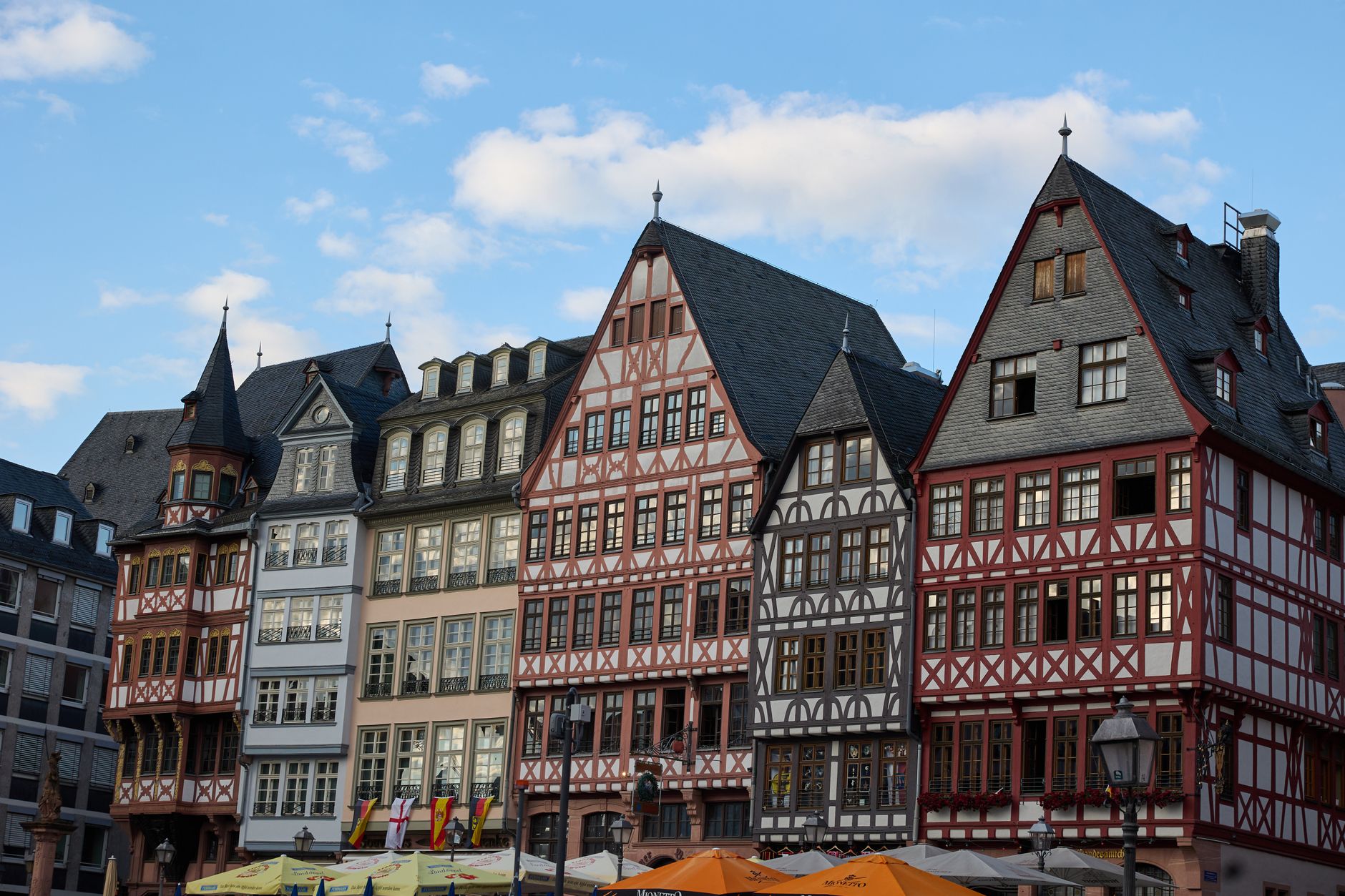
The Paulskirche is the building visitors to Frankfurt walk past most often without noticing. It sits between the Römerberg and the Hauptwache, an oval of red Main sandstone with a single tower and a strikingly flat copper roof, and next to the half-timbering of the New Old Town it looks almost apologetically plain. Yet in German history it matters more than any other address in the city. In May 1848 the first freely elected parliament for the whole of Germany met here; here a bill of basic rights was passed that, by a long detour, ended up in today’s constitution. And every October the Peace Prize of the German Book Trade is presented here.
It hasn’t been a church since 1944, by the way. Look for an altar and you won’t find one. What you find instead is one of the most idiosyncratic rooms of German post-war architecture, and it makes far more sense once you know how it was meant to be walked through.
A church that was a building site for almost half a century
The story starts with a demolition. In 1786 the medieval Barfüßerkirche, then Frankfurt’s main Lutheran church, was pulled down on this spot, and in 1789 work began on a replacement designed by the city architect Johann Friedrich Christian Hess. It wasn’t finished until 1833. In between came the Revolutionary Wars, empty coffers and years of standstill; the roof went on in 1796, the windows in 1802. The church was consecrated on 9 June 1833 and only received the name Paulskirche a fortnight earlier, because the old Franciscan name seemed wrong for a Protestant building.
What made it special from the start was its shape: a central, oval plan with a gallery running all the way round on twenty columns. Around 1,200 people could sit upstairs and more than 500 below. That capacity is exactly why it became interesting in 1848. It was simply the largest and most modern hall in town.
1848: Germany’s first parliament in a church
In the spring of 1848 Europe was in ferment. People across the states of the German Confederation demanded press freedom, a say in government and a common state, and within weeks a parliament had been elected, by most adult men, as the city of Frankfurt drily puts it today. On 18 May 1848 around 600 deputies filed into the Paulskirche. The pulpit was draped, the organ hidden behind a huge curtain painted with a Germania, and the president’s table took the place of the altar.
One story I’m particularly fond of: between November 1848 and January 1849 the assembly had to decamp for about forty sessions to the Reformed church on the Kornmarkt, because one of Germany’s first central-heating systems was being installed in the Paulskirche. The deputies had spent their first winter freezing.
By March 1849 there was an imperial constitution complete with civil and basic rights. It never took effect. The King of Prussia turned down the crown he was offered, uprisings in defence of the constitution were crushed, and at the end of May 1849 what was left of the parliament moved to Stuttgart, where it was broken up soon after. A failure, yes. But the basic rights of 1849 became a model for the Weimar constitution and for the Basic Law, which is why this building is still what John F. Kennedy called it in his speech here on 25 June 1963: the building with the strongest claim to be known as the cradle of German democracy.
Burnt out in 1944, back as the ‘House of All Germans’ in 1948
On 18 March 1944 the Paulskirche burnt out completely after an air raid. What happened next is one of the more remarkable stories of the post-war rebuilding. Frankfurt was hoping to become capital of a new West German state, and the church was to rise again in time for the centenary of the National Assembly. Mayor Walter Kolb declared it a task for all of Germany and appealed for donations from every occupation zone. Three railway wagons of timber arrived from Thuringia, leather for the seat covers from Offenbach, and even 10,000 marks from East Germany’s ruling SED. The foundation stone was laid on 17 March 1947, on the same day as one for the Friedrich-Ebert-Siedlung housing estate in the Gallus, so that nobody could claim the city was building symbols instead of homes. The Paulskirche reopened on 18 May 1948.
The rebuilding was led by the Cologne church architect Rudolf Schwarz, who decided against a reconstruction. The outer walls stayed; the tall domed roof and the galleries did not come back. Schwarz wanted a deliberately austere room that would make the hard road out of the war visible. People still argue about it. I think it’s magnificent.
Bottom to top: how to experience the room properly
The Paulskirche’s trick lies in its sequence, and most visitors never notice it. You enter through the tower and find yourself first in the foyer, known as the Wandelhalle: only about four metres high, low, dim, ringed by marble columns. Two staircases then curve up along the wall, and the assembly hall opens up above you, around 28 metres high, bright and almost empty. The city itself describes this path from darkness into light as Schwarz’s central idea. So do go round the lower floor first and then climb up, not the other way round.
Downstairs is the piece I urge every visitor not to miss: ‘Der Zug der Volksvertreter’ (The Procession of the People’s Representatives) by Johannes Grützke, a mural 32 metres long and three metres high running around the inner wall of the foyer. Grützke painted it in Berlin between 1989 and 1991, and it was unveiled on 16 April 1991. In the foreground stand the people as colourful, allegorical figures; behind them the deputies file past in grey and black towards a goal you can’t see. Look out for the executed Robert Blum, one of the few direct references to a real event. You may love it or loathe it, but you won’t forget it.
The foyer also houses the exhibition on the history of the Paulskirche, relaunched in 2022: the building’s story, the National Assembly, the great post-war speeches and a look at the site’s future. It is designed as a digital exhibition and can be viewed in full online too, which is handy if you want to read up afterwards.
Upstairs, the only decoration on the walls is a row of flags: those of the Federal Republic, the sixteen federal states and the city of Frankfurt. The seating looks more like a university hall than a church. Sit down for a few minutes. When the room is empty, it’s astonishingly quiet.
Around the outside: Ebert, Kennedy and the memorial
After your visit, take a slow walk round the building, because half a history book hangs on its walls. On the east side of the tower stands the memorial to Friedrich Ebert, Germany’s first president; Richard Scheibe recreated it in 1950 after the Nazis had removed the original in 1933. On the north-east side a relief plaque from 1966 recalls Kennedy’s visit. By the north-western stair tower stands Hans Wimmer’s memorial to the victims of National Socialism, in place since 1964, its plinth carved with the names of the concentration camps. Further plaques honour Heinrich von Gagern, president of the National Assembly, and Carl Schurz.
And if you hear Frankfurt’s great civic peal ringing out on certain days: the Paulskirche takes part with its Bürgerglocke, a bell of more than eight and a half tonnes cast in 1987, giving it the second-largest set of bells in the city after the cathedral. The bell commemorates the National Assembly’s proclamation of basic rights.
Opening hours, admission and getting there
The Paulskirche is open daily from 10am to 5pm and admission is free (as of 2026). You can visit the exhibition in the foyer and the great hall; the tower and other rooms are not open to the public. Worth knowing: the building closes entirely at times for events, and on the day of a ceremony such as the Peace Prize you won’t get in. For step-free access, speak to the staff at the main entrance, who will take you to the lift at the back of the building.
The address is simply Paulsplatz, 60311 Frankfurt. Take the U4 or U5 to Dom/Römer or trams 11, 12 and 14 to Römer/Paulskirche; from the Hauptwache S-Bahn station it’s about a ten-minute walk. If you’re driving in from the surrounding region, the centre is usually harder work than the train; the alternative is one of the park-and-ride sites around Frankfurt with a direct rail link, from which you reach the Römer without hunting for a space. The visit itself takes 45 minutes to an hour if you read the exhibition properly.
The Peace Prize: every October on book-fair Sunday
The Peace Prize of the German Book Trade has been presented in the Paulskirche since 1951, traditionally on the Sunday of the book fair. In 2026 that’s 11 October, and the laureate is the French-British lawyer and author Philippe Sands. The Board of Trustees calls him one of the most important intellectual voices of our time; the laudatory speech will be given by the historian Mirjam Zadoff, director of the Munich Documentation Centre for the History of National Socialism. German broadcaster ARD shows the ceremony live from 10.45am, and the prize carries €25,000. If you don’t know Sands yet, ‘East West Street’, his book on the origins of the legal concepts of genocide and crimes against humanity, is the place to start.
The hall is small and the ceremony is a television event, so for most visitors the live broadcast is the realistic way to be part of it. Still, it’s worth being nearby that morning, because around the Paulsplatz you feel that the book fair is more than a trade event. How to tackle the other fair days as a private visitor is covered in my Frankfurt Book Fair 2026 guide.
A practical note for that week: Frankfurt hotels are scarce and expensive during the book fair, and many visitors stay in Mainz or Wiesbaden instead. How far that really is shows up on the Frankfurt–Mainz route with drive time and an indicative taxi fare; and if you’re flying out from Wiesbaden, there’s a clear rundown of the cheapest ways from Wiesbaden to Frankfurt Airport.
The future: refurbishment and a House of Democracy
The Paulskirche’s future has been debated for years, and plenty of articles now say the refurbishment has already begun. That’s only half true. What began in spring 2026 is the planning: at the end of April 2026 the city appointed a design team led by the Frankfurt practice Wandel Lorch Götze Wach. Its job is to prepare a conservation-led overhaul of the stone façade, the copper roof with its skylight and the interior surfaces, plus new building services, lighting, sound and event technology, a new lift, revised seating with wheelchair spaces and better step-free access overall. The 1948 form stays; returning to the old domed roof has been off the table since 2019. The city has so far published no official date for the start of construction or for any closure. As of September 2026, the Paulskirche is open as normal.
Alongside it a House of Democracy is planned, close by and as a complement rather than a replacement: a place for civic education, exhibitions and debate, with the Paulskirche itself as its ‘main exhibit’. City councillors agreed the idea in principle in 2019, an ideas competition produced ten prize-winning designs, and in August and September 2025 more than 2,000 residents took part in the public discussion. There was no clear favourite. On 5 March 2026 the council approved the start of planning for the design competitions that will decide what actually gets built. Press reports last year spoke of construction on the House of Democracy from 2028/29 and about five years to complete the whole ensemble; none of that is binding yet. If you want to see the Paulskirche as it is now, don’t wait too long, but don’t assume it’s closed either.
My morning around the Paulsplatz
When friends have just one morning in the old town, I send them into the Paulskirche first at around ten, while it’s still quiet: Grützke and the exhibition downstairs, five minutes on the chairs upstairs, then the circuit round the plaques outside. From there it’s a few minutes across the Römerberg to the cathedral, where the kings were elected whose empire the deputies of 1848 wanted to remake. What to see there, and whether the 328 steps up are worth it, is in my piece on Frankfurt Cathedral and its tower. The Schirn next door is currently hidden behind scaffolding, incidentally; its programme runs until around 2028 in an old printworks in Bockenheim, Frankfurt’s former university quarter.
Come in Advent and the Paulsplatz is a different place: it becomes part of the Christmas market, which in 2026 runs from 23 November to 22 December, with stalls right up to the church walls. My favourite corners of the market are in my Christmas market guide. And if your flight home is the same day, a level-headed guide to departing from Frankfurt Airport tells you how much time the terminal really needs; the S-Bahn to the airport is quick to reach from the Hauptwache.
The Paulskirche doesn’t make things easy for you. There’s no treasury and no viewing platform, and if all you want is a quick photo you’ll be back outside in two minutes. But give it an hour, start at the bottom and end at the top, and there are few places in Germany where you grasp so directly how hard the road to democracy was, and how plain the room built for it after 1945 turned out to be.
Keep reading
Attractions
Frankfurt Cathedral: Election Chapel, the 328-Step Tower and the Dommuseum
Frankfurt's Kaiserdom St Bartholomew's, where kings were elected and emperors crowned: what to see inside, 2026 opening hours and prices for the cathedral tower (66 metres, 328 steps), the Dommuseum in the cloister and the tower-keeper's rooms.
Katharina Vogt25 September 2026
Attractions
Archaeological Museum Frankfurt: Tickets, Highlights & Tips
The Archaeological Museum Frankfurt inside the Gothic Carmelite church: Roman finds from NIDA, Mithras reliefs, the Ratgeb frescoes, the Silver Inscription — plus current prices, opening hours and tips from a local.
Katharina Vogt28 June 2026
Attractions
Caricatura Museum Frankfurt: Comic Art on the Weckmarkt
Cartoons, caricatures and the New Frankfurt School inside the medieval Leinwandhaus: opening hours, admission (€8/€4), highlights and tips for your visit to the Caricatura Museum Frankfurt.
Katharina Vogt25 June 2026
Attractions
Historical Museum Frankfurt: Saalhof, Highlights & Tickets
The Historical Museum Frankfurt at the Saalhof: the Staufer-era old building and the 2017 new building, the Treuner brothers' old-town model, the Snow Globe, the Young Museum, plus current prices and opening hours (as of 2026).
Katharina Vogt20 June 2026