Goethe House & Romanticism Museum Frankfurt: Tickets & Tips
Where Goethe was born in 1749 and began 'Faust': the faithfully rebuilt Goethe House and the neighbouring German Romanticism Museum bring the 18th century to life — one combined ticket, a puppet theatre and a stairway to heaven.

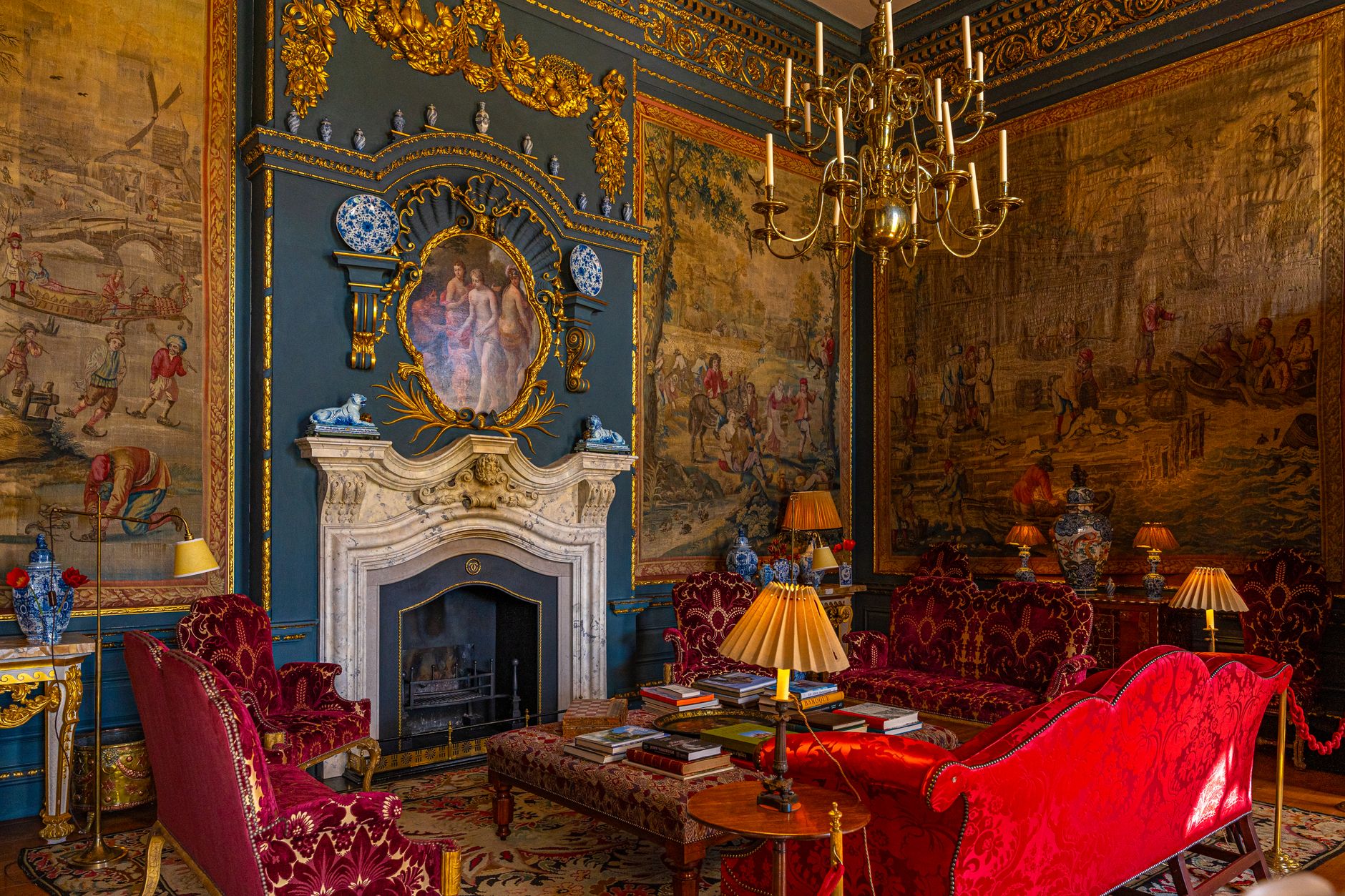
The Großer Hirschgraben is not a street you simply pass on your way somewhere else. It lies a few steps off the Zeil, quiet and almost hidden between the modern centre and the old town — and it was here, in a narrow townhouse, that Johann Wolfgang von Goethe came into the world on 28 August 1749. I’ve been to the Goethe House several times over the years: with school groups, with relatives visiting from abroad, and once entirely on my own on a rainy Tuesday morning. Each time I’m surprised anew by how directly the 18th century speaks to you here. Since 2021 the German Romanticism Museum has stood right next door, and the two houses together make one of the most rewarding cultural visits in the whole city.
An original that is one no longer
What you step into today is, strictly speaking, a copy — and that is a story in itself. On the night of 22 March 1944 the Goethe House was bombed to its foundations in an Allied air raid. But the Freies Deutsches Hochstift — the civic learned society that had already acquired the house in 1863 — had taken precautions: the furniture, the paintings, the wall panelling and even the ornate fittings had been moved to safety in good time. From 1947 the house was rebuilt in faithful detail using surviving plans and photographs, and it reopened in 1951.
The reconstruction was controversial at the time; some felt that rebuilding it at all was somehow dishonest. But the result vindicates the Hochstift: you walk through rooms proportioned exactly as they were in Goethe’s day, filled with the original pieces that survived the war in storage. Knowing this, you see the place differently — it is at once the poet’s birthplace and a monument to Frankfurt’s stubborn refusal to let its cultural memory be taken from it.
Room by room through Goethe’s childhood
The house has four floors and eighteen rooms, plus an attic and a cellar. Goethe’s father, the lawyer Johann Caspar Goethe, had the two original small houses rebuilt around 1755 into an imposing Baroque townhouse — a status symbol of its day. The tour begins downstairs in the kitchen, perhaps the most down-to-earth room in the house. What catches the eye at once is the built-in water pump: running water in your own home was, in the mid-18th century, a luxury that by no means every household enjoyed.
A floor higher, on the second-floor stairwell, stands the astronomical clock, the so-called Hüsgen clock of 1746. It shows not just the hour but the days of the week, the months, the phases of the moon and the movement of the heavenly bodies. Young Johann Wolfgang was so captivated by this marvel that he still recalled the “wondrous clock” decades later in his autobiography Poetry and Truth. Standing in front of it is one of those moments when nearly three hundred years suddenly shrink to nothing.
On the second floor lie the living and reception rooms: the Garden Room, named for a view of a long-vanished neighbouring garden, the parents’ bedroom, and the formal parlours with their Frankfurt furniture and fabric-hung walls. I’m especially fond of the father’s library — Johann Caspar Goethe was a passionate collector, and his book collection filled an entire room. His small picture gallery of paintings by contemporary Frankfurt artists hangs in its place once more, too. It was on these pictures that the boy first trained his eye, and painting would accompany him all his life.
The puppet theatre and the room where ‘Werther’ was written
On the third floor waits the room that usually holds families with children the longest: the puppet theatre. At Christmas 1753, Goethe’s grandmother gave the four-year-old and his sister Cornelia just such a puppet stage — a gift the boy could not put down. He learned the plays by heart and performed them again and again with his friends. This early passion for theatre later fed into works such as Wilhelm Meister and his lifelong fascination with the Faust legend, which he had first encountered as a puppet play.
Right at the top lies the poet’s room, his study as a young man. Here, at a plain standing desk, he produced some of his first major works between 1771 and 1775: the drama Götz von Berlichingen, the epistolary novel The Sorrows of Young Werther — which made him famous across Europe practically overnight — and the earliest scenes of what would, decades later, become Faust. Standing before this unassuming desk, literary history becomes very concrete for a moment: this is no grand salon but a working room under the eaves, where a man in his mid-twenties turned German literature upside down.
The German Romanticism Museum next door
Since 14 September 2021, the German Romanticism Museum has adjoined the Goethe House directly — the first museum anywhere devoted to the Romantic era in its full breadth. The building alone makes a statement. The architect Christoph Mäckler designed a façade that evokes three historic gabled houses, with a striking blue bay window that nods to the “blue flower”, Romanticism’s great symbol of longing. Inside, a boldly sweeping, deep-blue staircase — the Himmelstreppe (“stairway to heaven”) — rises through three floors and seems to have no end; almost incidentally, it keeps daylight away from the sensitive exhibits.
Across some 2,000 square metres the museum shows the largest collection of German Romanticism anywhere: original manuscripts and letters by Novalis, Clemens Brentano, Joseph von Eichendorff, the Schlegel brothers and Bettina von Arnim, alongside paintings from the circle of Caspar David Friedrich. Instead of dry rows of display cases, you’ll find atmospherically staged rooms that bring literature, painting and music together. The pairing of the two houses is ideal: first you immerse yourself in Goethe’s world, then in the intellectual current that followed him. If you’re in a museum mood anyway, it’s worth looking into the Museumsufer and its museum mile across the river.
Opening hours (as of 2026)
The Goethe House and Romanticism Museum share an entrance and opening hours:
- Monday to Wednesday, Friday to Sunday and public holidays: 10 a.m. to 6 p.m.
- Thursday: 10 a.m. to 9 p.m.
So both houses are open seven days a week — including Mondays, which is genuinely unusual for a museum. They close only on 24, 25 and 31 December and on 1 January. The long Thursday evening is my personal insider tip: it’s noticeably quieter than the weekend, and you often have the staged rooms almost to yourself.
What admission costs (as of 2026)
Pleasingly straightforward: a single combined ticket covers both houses — you pay once and see everything.
- Adults: €12 (€15 with a special exhibition)
- Students and trainees: €7
- Reduced (incl. disability of 50%+, unemployed, Frankfurt-Pass holders): €5
- School pupils: €3
- Children under 6: free
- Family ticket (up to 2 adults with their own children up to 18): €18
Contrary to what many assume, admission for young people is not entirely free: only children under six get in for nothing, while school pupils pay a reduced €3. For parents with several children, the €18 family ticket is still a fair deal. And a real money-saver on top: on the first Thursday of every month, between 6 and 9 p.m., the “Feierabend im Museum” (after-work) rate applies — both houses together then cost just €1. Anyone holding a MuseumsuferCard or the Museumsufer ticket gets in free anyway. Tickets are sold only on site at the box office; online reservation isn’t available.
Getting there
The Goethe House is at Großer Hirschgraben 23–25, 60311 Frankfurt am Main, right in the city centre; the entrance and box office are in the foyer of the Romanticism Museum (house number 21). The quickest way is by S-Bahn or U-Bahn to Hauptwache — barely a five-minute walk away. Practically every S-Bahn line stops there (S1–S6, S8, S9), as do U-Bahn lines U1, U2, U3, U6, U7 and U8. On lines U4 and U5 you alight at Dom/Römer, while trams 11, 12 and 14 stop at Karmeliterkloster. The Römerberg and the old town are only a few minutes on foot, so if you like you can combine the visit with a historic walk through Frankfurt’s old town. I’d advise against the car in the centre — the car parks are expensive, and the train drops you right on the doorstep with no fuss.
How I’d spend half a day here
Allow two to three hours for both houses together, ideally a little more, because the Romanticism Museum tempts you to linger. I like to start in the Goethe House while I’m still fresh and receptive, working my way up from the ground-floor kitchen to the poet’s room under the roof. Then I cross over into the Romanticism Museum, where you should simply let yourself drift through the atmospherically lit rooms rather than trying to read every caption. Afterwards I treat myself to a coffee in one of the cafés around the Hauptwache or the Römer and let it all settle.
If you have more time, tack the Goethe House onto a bigger city walk — it slots neatly in among Frankfurt’s 15 top attractions, nearly all of which are within walking distance. On a rainy day the combination of the Goethe House and Romanticism Museum is hard to beat anyway: two to three hours fully sheltered from the weather and yet genuinely substantial.
The Goethe House is not a place to tick off and forget. It tells not of marble and power but of a middle-class childhood from which one of world literature’s greatest writers emerged — and it makes you feel that a curious child grew up here who would change the German language for good. Come on a quiet morning or on the long Thursday evening, take your time over the small details, and you’ll leave the Großer Hirschgraben seeing Frankfurt’s most famous son in an entirely new light.
Keep reading

Attractions
Senckenberg Natural History Museum Frankfurt: Dinos, Messel & Tips
From the 18-metre Diplodocus and a genuine dinosaur mummy to the world-famous Messel fossils: current admission prices, opening hours, highlights and family tips for the Senckenberg Natural History Museum — from a local.
Katharina Vogt19 June 2026
Attractions
Struwwelpeter Museum Frankfurt: Heinrich Hoffmann, Tickets & Tips
The Struwwelpeter and Heinrich Hoffmann Museum in Frankfurt's New Old Town (Hinter dem Lämmchen 2–4): how the world's most famous shock-headed boy was created in 1844, what the exhibition shows, plus admission, hours and how to get there (as of 2026).
Katharina Vogt11 July 2026
Attractions
Caricatura Museum Frankfurt: Comic Art on the Weckmarkt
Cartoons, caricatures and the New Frankfurt School inside the medieval Leinwandhaus: opening hours, admission (€8/€4), highlights and tips for your visit to the Caricatura Museum Frankfurt.
Katharina Vogt25 June 2026
Attractions
Museum of Communication Frankfurt: Behnisch Building, Tickets & Tips
The glass Behnisch building on the Museumsufer, Nam June Paik's robot Pre-Bell-Man and hands-on stations for children: admission, opening hours and tips for the Museum of Communication Frankfurt.
Katharina Vogt23 June 2026