Frankfurt's New Old Town: Dom-Römer Quarter, History & Walk
35 houses, 15 faithful reconstructions and a showpiece called the Golden Scales: how Frankfurt won back its lost old town between 2012 and 2018 — and why the walk is worth your time.

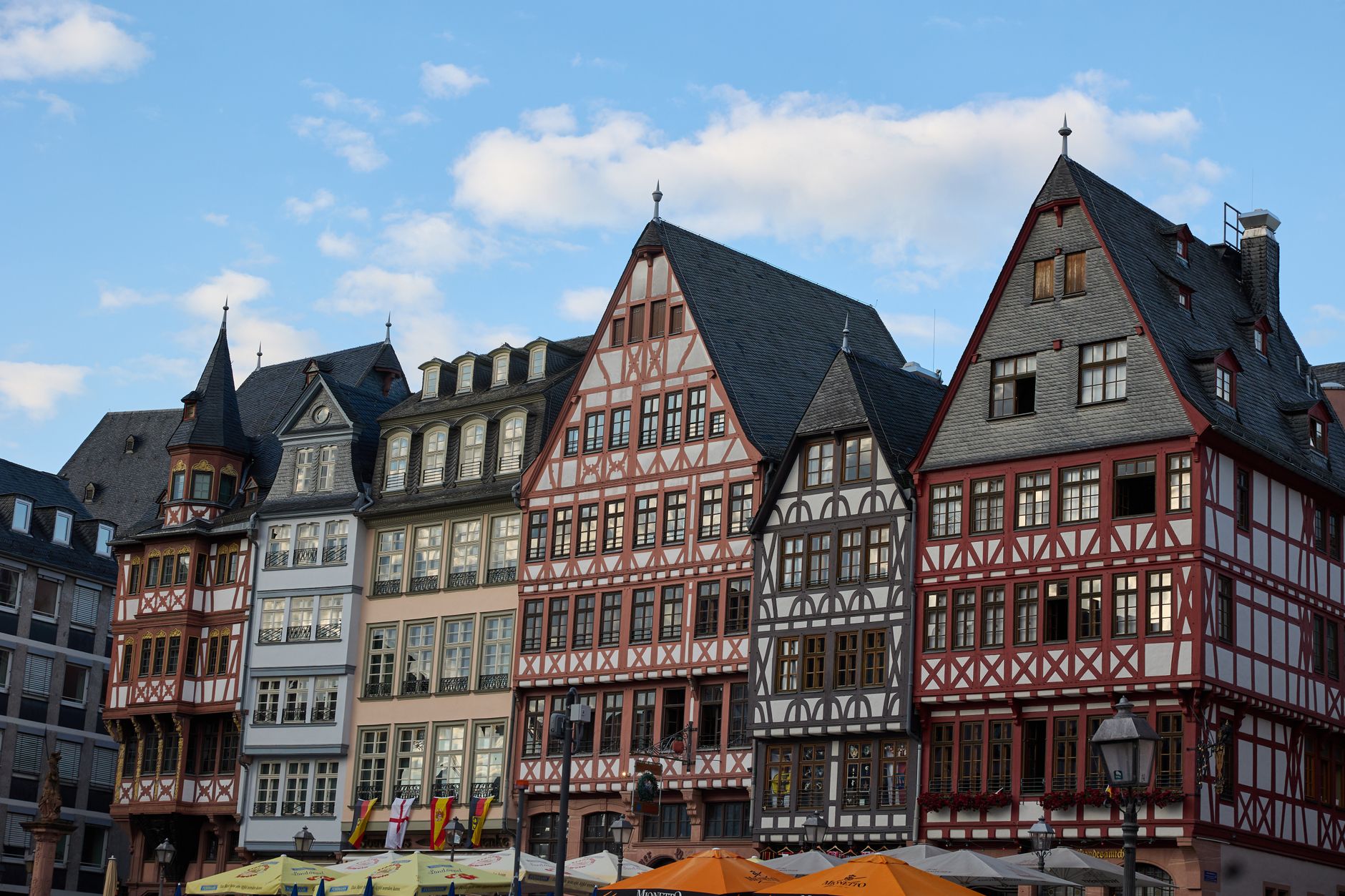
There is hardly a place in Frankfurt that throws visitors off balance as reliably as the New Old Town. You wander through narrow, cobbled lanes, look up at turned timber-framed gables, catch the smell of waffles drifting from a tiny shop — and you’re utterly convinced you’re walking through a centuries-old quarter. Then the penny drops: this “old town” is younger than the smartphone in your pocket. The quarter between the Imperial Cathedral and the Römer only opened in May 2018. As a Frankfurter, that is exactly what fascinates me about the spot — and the reason I almost always bring visitors here first.
From Germany’s largest timber-framed ensemble to a field of rubble
To understand why this quarter stirs up so much feeling, you need to know what once stood here. Until the Second World War, Frankfurt possessed one of the largest medieval old towns in Germany — a densely packed tangle of around 1,250 timber-framed houses, alleys and courtyards that had grown over centuries. In the bombing raids of March 1944, that ensemble was almost entirely wiped out. What survived the war were foundations, a handful of stone portals, and memory.
After the war the site remained a wound in the cityscape for a long time. Then, in the 1970s, of all things a brutalist concrete slab was dropped here: the Technical City Hall (Technisches Rathaus), opened in 1974 and disliked by many Frankfurters from the start. Only when that block was demolished in 2010–2011 did a rare gap open up in the historic core — and with it the chance to rethink the lost quarter.
35 houses, 15 reconstructions: the Dom-Römer project
Between 2012 and 2018, the Dom-Römer project created one of the most ambitious pieces of urban planning in recent German history. On roughly 7,000 square metres between the Römerberg and the Domplatz — bounded to the north by Braubachstraße and to the south by the Schirn art gallery — 35 houses were newly built. Of these, 15 are so-called creative reconstructions: rebuilds of historic old-town houses that are as faithful as possible, some of them incorporating surviving spolia — original components such as portals, coats of arms, corbels or figures that had outlasted the war in storage. The remaining 20 buildings are contemporary new-builds that deliberately fit into the historic picture in scale, material, window rhythm and roof shape, without faking half-timbering.
The quarter opened to the public on 9 May 2018, and from 28 to 30 September 2018 Frankfurt celebrated with a large old-town festival that drew, depending on the count, between 250,000 and 300,000 people. The total cost came to around €200 million, of which about €75 million was recouped through the sale of the flats. And that is worth knowing: the New Old Town is not an open-air museum but a lived-in quarter. People live above the shops and cafés — behind many a magnificent gable there is simply an expensive owner-occupied flat.
The Hühnermarkt: the heart of the quarter
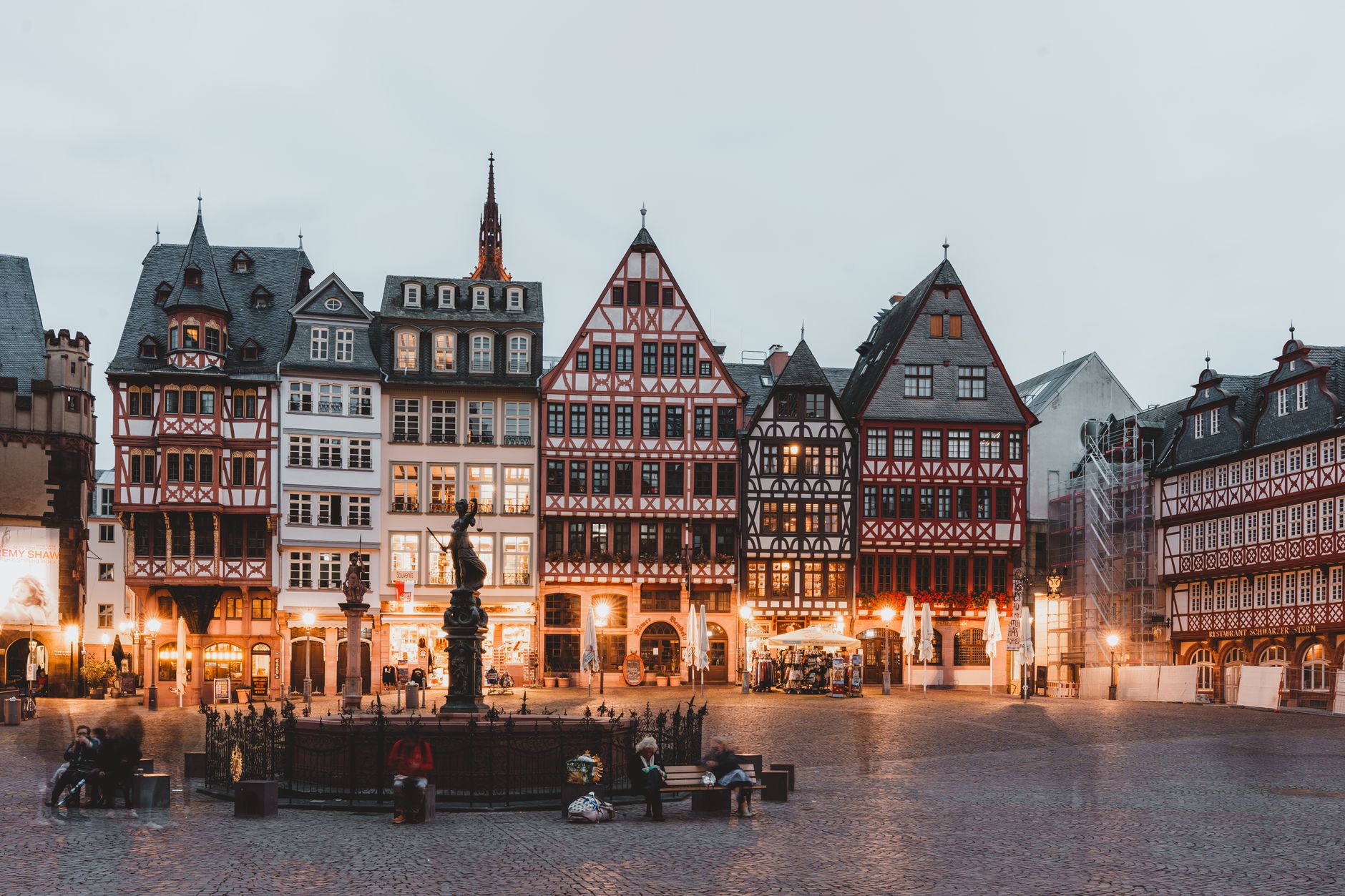
The heart of it all is the Hühnermarkt, a small, irregularly shaped square where the life of the quarter gathers. In the middle stands the Stoltze Fountain, named after Friedrich Stoltze (1816–1891), Frankfurt’s most famous dialect poet and satirist, founder of the weekly paper “Frankfurter Latern”. The lovely thing about this dedication: Stoltze really was born on the Hühnermarkt, in his parents’ inn “Zum Rebstock”. So the fountain now stands almost exactly where it belongs.
Around the square, the finest reconstructions line up shoulder to shoulder, many with outdoor tables. On a mild afternoon the Hühnermarkt is the best place to sit down with a coffee or a glass of apple wine and let the façades work on you — from the tall, narrow gabled construction to the colourful paintwork that post-war Frankfurt went without for so long.
The Golden Scales — the showpiece
If you look closely at only one house in this quarter, make it the Haus zur Goldenen Waage (House of the Golden Scales) at Markt 5. This richly decorated late-Renaissance timber-framed house was originally built around 1618–19 for a spice merchant who had moved to Frankfurt from the Netherlands, and it counted among the grandest town houses of the old city. Its signature feature is the “Belvederchen”, a delicate glazed rooftop garden right at the top, from which you once looked out across the roofs.
The Golden Scales was the most demanding single reconstruction of the entire project — craftspeople rebuilt the carved façade piece by piece from historic photographs and building plans. Today the house belongs to the Historical Museum Frankfurt and houses a café as well as a small branch of the Stoltze Museum. It’s worth stepping inside briefly — if only for the staircase and the view upwards.
Along the emperors’ coronation route
What many visitors never notice: you are walking on historic ground here in the most literal sense. Between 1562 and 1792, ten Holy Roman emperors were crowned in the Imperial Cathedral of St Bartholomew. After the ceremony, the newly crowned emperor processed in state to the Römer, where the coronation banquet was held. That route — the Krönungsweg (Coronation Route) — ran straight through the old town, and it is exactly this line that the main axis of the New Old Town follows today, between the cathedral and the Römerberg. So as you walk from east to west through the lanes, you are literally following in the footsteps of emperors. If you’d like to dig deeper into this history, I recommend my historic walk through the old town and the Römer as a companion piece.
Stadthaus, the Archaeological Garden and the view to the cathedral
At the eastern edge, right on the Domplatz, stands the Stadthaus am Markt, built between 2013 and 2016. At first it reads as a modern block, but it holds a special treasure beneath it: the Archaeological Garden. Here lie the excavated foundations of a Roman settlement and a Carolingian royal palace — traces of the time when Charlemagne himself resided on this spot. The Stadthaus roofs over these digs, so they are both protected and freely accessible. You walk, in effect, across two thousand years of city history.
From here you also get the loveliest view of the cathedral tower, which at 95 metres was for centuries the tallest structure in the city. When the viewing platform is open, the climb of a good 300 steps rewards you with a panorama that unites the timber-framed roofs of the New Old Town and the banking towers in a single glance — nowhere else do Frankfurt’s two faces lie so close together.
Shops, cafés and the Struwwelpeter
The New Old Town is not a mere museum zone; it lives off small businesses: bookshops, crafts, jewellery, wine, with cafés and wine bars in between. Take your time to look into the courtyards and shop windows — much of the charm only reveals itself in the detail.
A real highlight, especially with children, hides in the reconstructed Haus zum Esslinger in the lane called Hinter dem Lämmchen (no. 2–4): the Struwwelpeter Museum. It moved here in 2019, and its redesigned rooms won the German Design Award in 2022. Everything revolves around Heinrich Hoffmann and his famous, rather gruesome children’s-book character, which was created in Frankfurt. If you like, read my full piece on the Struwwelpeter Museum beforehand.
Stage set or identity? The debate is part of the deal
To be honest: not everyone finds the New Old Town a success. Critics speak of a prettified stage set, of “Disneyland”, of a longing for a past that never quite existed. Supporters counter that a piece of destroyed civic identity has been deliberately won back here — seriously crafted, with genuine spolia and a great deal of research. I stand somewhere in the middle, and that’s precisely what I find appealing: this quarter is not real medieval fabric, but nor is it a cheap imitation. It is an honest, expensively bought attempt, and the friction it creates is what makes the walk interesting in the first place. Feel free to form your own judgement on the spot — the debate is part of the place.
My walking tour of the New Old Town
When friends ask me how best to experience the quarter, I suggest this order. Start at the Römerberg with its famous timber-framed gables and the Römer, Frankfurt’s town hall. From there, dive eastwards into the lanes and follow the coronation route. Take your time for a break on the Hühnermarkt, glance into the Golden Scales, and let yourself drift through the side alleys. On the Domplatz, look into the Archaeological Garden, then into the Imperial Cathedral — and if you still have the appetite, walk a few steps further to the Historical Museum, where the legendary old-town model by the Treuner brothers shows how the quarter really looked before its destruction. No visit makes the reconstruction as tangible as that comparison.
A few practical things to help you get your bearings:
- Getting there: easiest by U-Bahn to the Dom/Römer station (U4/U5). The whole quarter is car-free and can only be explored on foot.
- Cost: wandering around is free — the New Old Town is an open quarter, not a ticketed attraction. You only pay for the museums, the cathedral tower and your coffee.
- Best time: early morning or late afternoon, when warm light falls on the façades and the tour groups have gone. Weekends and the Christmas season get busy.
- How long: the loop alone takes 45 to 60 minutes. With the cathedral, the museum and a coffee break, reckon on a half day.
For me, the New Old Town is one of the cleverest places in Frankfurt, because it poses a simple question: what is a city willing to do for its memory? Walk slowly, read the little plaques on the houses, look into the courtyards — and the next time you glance at the skyline, picture the fact that a few hundred metres away, between the cathedral and the Römer, a piece of the Middle Ages has been reinvented. If it leaves you wanting more, you’ll find the right next destinations in my overview of the 15 top attractions in Frankfurt.
Keep reading
Attractions
Frankfurt Old Town & Römer: A Historic Walk
A walking route through Frankfurt's old town with fixed stops: the Römerberg, the Römer, the Kaiserdom, the New Old Town, the Paulskirche, the Kleinmarkthalle and the Eiserner Steg — with history, walking times and honest tips from a local.
Katharina Vogt16 June 2026
Attractions
Höchst Old Town Frankfurt: Timber-Framing, Castle & Justinus Church
Höchst in Frankfurt's west: the only old town that survived the war — with the Carolingian Justinus Church, the castle on the Main, the Bolongaro Palace and timber-framed lanes. Getting there, the Schlossfest and my walking route.
Katharina Vogt10 July 2026
Attractions
Struwwelpeter Museum Frankfurt: Heinrich Hoffmann, Tickets & Tips
The Struwwelpeter and Heinrich Hoffmann Museum in Frankfurt's New Old Town (Hinter dem Lämmchen 2–4): how the world's most famous shock-headed boy was created in 1844, what the exhibition shows, plus admission, hours and how to get there (as of 2026).
Katharina Vogt11 July 2026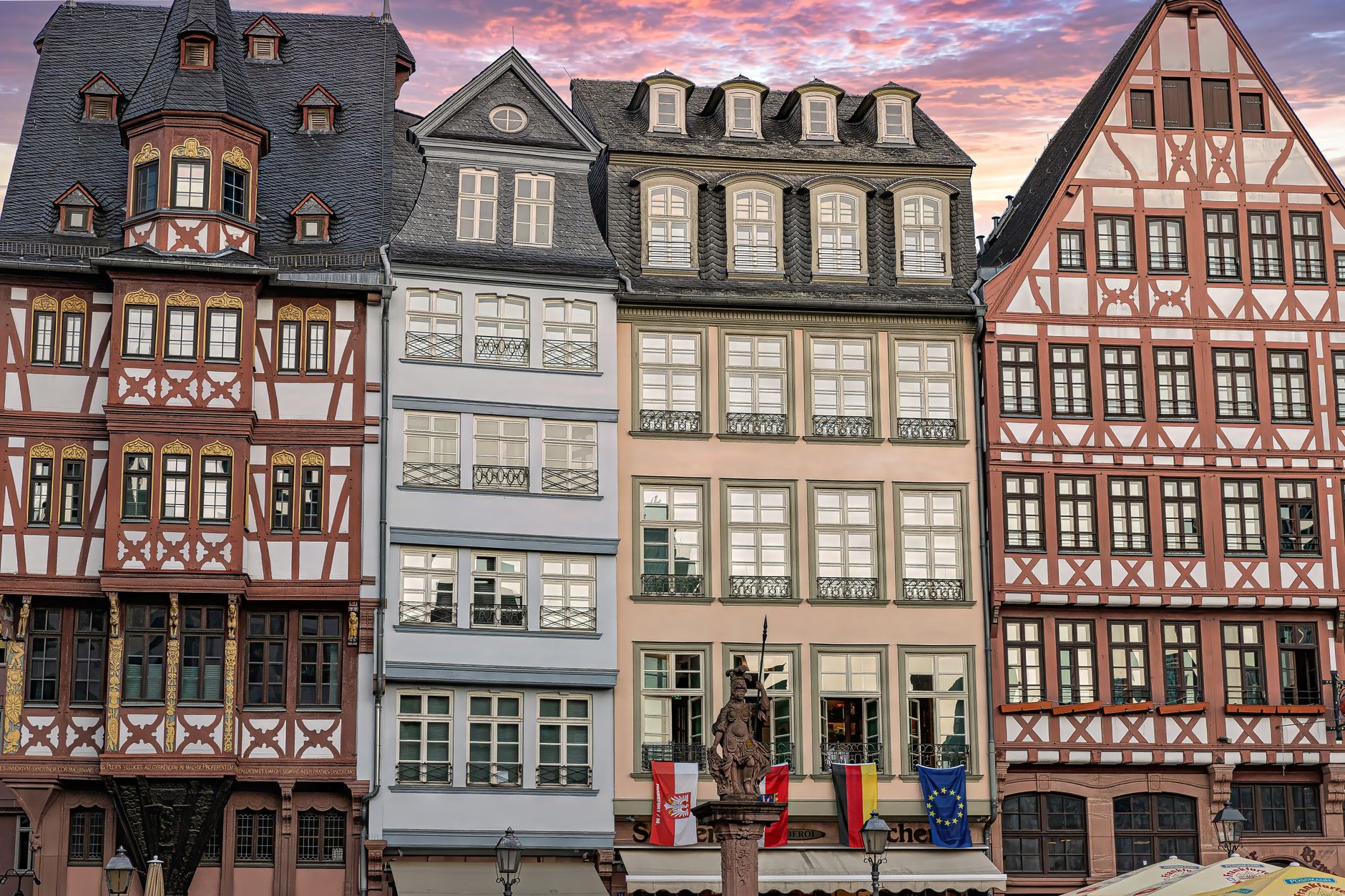
Attractions
Historical Museum Frankfurt: Saalhof, Highlights & Tickets
The Historical Museum Frankfurt at the Saalhof: the Staufer-era old building and the 2017 new building, the Treuner brothers' old-town model, the Snow Globe, the Young Museum, plus current prices and opening hours (as of 2026).
Katharina Vogt20 June 2026