Theatre in Frankfurt: Schauspiel, English Theatre, Tigerpalast and More
One evening, no German: which stage is right for you? A local sorts Frankfurt's theatres by how much language they demand, lists this season's prices and explains how to see serious drama for €9.

When friends from abroad come to stay, the question arrives almost every time: “Can we go to the theatre, even though we don’t speak German?” The honest answer is yes, and rather well, but not everywhere. For a city of its size Frankfurt has a surprisingly broad stage scene: a drama house that calls itself the largest spoken-word stage in the German-speaking world, the biggest English-language theatre on the Continent, a variety theatre with an international name, a dialect stage right next door to Goethe’s birthplace, and a production house for dance and performance where words are often beside the point. Which one suits you depends less on taste than on a single question: how much German do you need for the evening to work?
I’m deliberately leaving the opera out of this. It shares a building with the Schauspiel, but it deserves a piece of its own, and how to get good seats cheaply there, and what is going to happen to the tired glass building on Willy-Brandt-Platz, is in my guide to Frankfurt opera tickets and cheap seats.
The language question first
Before going house by house, here is the rough sorting I use for visitors:
- No German at all: the English Theatre, the Tigerpalast, much of the Mousonturm’s programme.
- A little German, or happy to read surtitles: the Schauspiel Frankfurt on its English-surtitled nights.
- Good German and a taste for dialect: the Volksbühne im Großen Hirschgraben.
That matters more than any review. A brilliant Brecht production is wasted if you spend three hours following only the body language. A night of variety at the Tigerpalast, on the other hand, works beautifully for guests who don’t speak a word of German, even though the compère talks in German.
Schauspiel Frankfurt: the big stage on Willy-Brandt-Platz
The Schauspiel Frankfurt is the largest drama company in the Rhine-Main region and plays four stages: the main Schauspielhaus, the Kammerspiele, the tiny Box, and the Bockenheimer Depot, a former tram shed out at Bockenheimer Warte. The Schauspielhaus is a giant: 689 seats, a proscenium 24 metres wide and a stage 40 metres deep. The Kammerspiele are its intimate counterpart, with 187 black leather seats; the Box holds just 66.
The company’s history is as political as the city. On 14 December 1963 it opened the new double theatre building with Goethe’s Faust. Under the director Harry Buckwitz, fifteen Brecht plays reached the stage; in the seventies the ensemble ran a co-determination experiment unique in Germany; and in 1985 audience members occupied the stage to stop a performance of Fassbinder’s Der Müll, die Stadt und der Tod. Anselm Weber has been artistic director since the 2017/18 season.
The 2026/27 programme keeps that tradition alive. Brecht’s The Resistible Rise of Arturo Ui is back in the Schauspielhaus from 18 September with a new epilogue by Soeren Voima; its costume designer, Josa Marx, was nominated for Germany’s FAUST theatre award in 2026. New this season is a Good Soldier Švejk trilogy that walks Hašek’s holy fool from the First World War all the way to Ukraine, and Edward II premieres on 13 February 2027.
English surtitles, and where to sit for them
For international visitors, one line on the Schauspiel’s website is the important one: a number of productions are performed on selected dates with English surtitles. The dates are marked in the monthly schedule, and the theatre itself recommends rows 10 to 20 for a good view of them. Right at the front you’ll crane your neck; right at the back the text gets small. If the play you want has no surtitled date during your stay, the audio introduction the company records for every new production can help, though it is in German.
What tickets cost
The Schauspiel uses price groups and categories that are shown against each date in the schedule. The ranges are easy enough to grasp (as of 2026):
- Schauspielhaus: from €14 in the cheapest price group up to €68 in the top category.
- Kammerspiele: €15 to €46.
- Box: €15, concessions €9, unreserved seating.
- Bockenheimer Depot: priced per event in the monthly schedule.
It gets properly cheap if you’re young: school pupils, students and trainees up to the age of 30 pay a flat €9, or €11 for premieres and guest performances. Several times a season there is also a Theatertag when every ticket for a performance costs €14. And this autumn there’s an offer couples will like: from 4 to 17 October 2026, marked performances are two tickets for the price of one, full-price tickets only, while stocks last.
Booking opens on the 10th of the preceding month. The Schauspiel’s own web shop charges no booking fee; the central box office of the Städtische Bühnen is to the right of the Schauspielhaus entrance and opens Monday to Friday 10 a.m. to 6 p.m. and Saturday 10 a.m. to 2 p.m. The evening box office opens an hour before curtain up. A perk most visitors miss: your ticket doubles as a return journey anywhere on the RMV network, valid from five hours before the performance until the end of service.
The English Theatre: West End in a bank tower
If English is your only language, the English Theatre is the safe bet, and it’s a favourite with plenty of Frankfurters too. It was founded in 1979 in Sachsenhausen, moved to a hall on Kaiserstraße in 1990, and in 2003 settled into the lower floors of the Gallileo tower on the corner of Gallusanlage and Kaiserstraße. With the 300 seats it opened with there, it has long described itself as the largest English-language theatre on the European mainland.
The last few years were turbulent. While the Gallileo was being refurbished, the company spent about two years in the Zoogesellschaftshaus in the Ostend. It has been back in the Gallileo since early 2026, and the official reopening was celebrated on 24 April 2026 with the mayor, Mike Josef, and the ECB president, Christine Lagarde, because the office floors above the stage are now used by the European Central Bank. So if an older guidebook sends you to the zoo, ignore it. The entrance is at Gallusanlage 7 (the postal address is Kaiserstraße 34), and the nearest stop is Willy-Brandt-Platz.
The 2026/27 season is classic English Theatre, a mix of British comedy, musical and a proper scare:
- Single Spies, Alan Bennett’s double bill about the Cambridge spies, until 1 November 2026.
- Kinky Boots, the musical with songs by Cyndi Lauper, 22 November 2026 to 21 March 2027.
- 2:22 A Ghost Story by Danny Robins, 17 April to 20 June 2027.
Performances are Tuesday to Saturday at 7.30 p.m. and Sunday at 6 p.m. Prices differ for plays and musicals (as of 2026): a play costs €31 to €39 midweek and €35 to €43 on Friday and Saturday; a musical €47 to €60 midweek and €52 to €65 at weekends. Student tickets run from €17 to €27 but only from row eight back. My tip: in the first week of every production there are early-bird tickets at 25 per cent off. There is no longer a senior discount. The box office is open Tuesday to Friday 11 a.m. to 6.30 p.m., Saturday 3 to 6.30 p.m. and Sunday 3 to 5 p.m. Afterwards people tend to linger at James the Bar in the building, and if you want to carry on, the Bahnhofsviertel starts a couple of streets away.
Tigerpalast: variety that needs no translation
On 30 September 1988, Margareta Dillinger, Johnny Klinke, Robert Mangold and the cabaret artist Matthias Beltz opened a variety theatre on Heiligkreuzgasse. It was a bold idea then; today it is a Frankfurt institution. The Tigerpalast is small and intimate, you sit at tables, and on stage artists do things you’d have sworn were impossible, accompanied by a live variety orchestra.
The 2026/27 season opened on 17 September. The first programme, running until 28 February 2027, includes the Canadian artist Valérie Inertie with her Cyr wheel, a giant spinning hoop, and the hula-hoop performer Romina Micheletty from a French circus dynasty. The compère speaks German, but the acts themselves need no language at all, which is why I send international guests here with a clear conscience.
It isn’t cheap (as of 2026): a show ticket costs €89 on Thursdays and Sundays and €95 for the first show on Fridays and Saturdays, rising to €98 in December. With a three-course dinner in the Tiger-Gourmetgastronomie, run for years by the chef Coskun Yurdakul, you’re looking at €175 per person and up. Shows run Thursday to Sunday, though Thursday performances only start from 15 October 2026. Children up to 12 pay half, and the house recommends it from age six; pupils and students get 25 per cent off. There’s no dress code as such; the theatre suggests “smart casual”. Konstablerwache station is a few minutes’ walk away, and drivers can use the Am Gericht car park next door.
Two addresses for the curious
The Volksbühne im Großen Hirschgraben has had its own house since September 2019, practically next door to the Goethe House. Its face is the actor Michael Quast and its trademark is Frankfurt dialect: Quast reads the local satirist Friedrich Stoltze, performs musical comedy evenings with Sabine Fischmann, and this season stages Goethe’s Urfaust “with an unmistakably Frankfurt accent”, as the theatre puts it. Wonderful if your German is very good. For everyone else it is the one evening I don’t recommend; even my friends from Hamburg miss some of the jokes.
The Mousonturm at Waldschmidtstraße 4 is an artists’ house in the tower of a former soap factory and Frankfurt’s home for dance, performance and international guest productions. Many pieces work without text or are performed in English, and the programme has an English version. Most events use a solidarity pricing system in which you choose between four price levels yourself. For evening events the box office opens two hours beforehand. The nearest U-Bahn is Merianplatz (U4), about 500 metres away.
Which evening suits which guest
This is how I match my own visitors, and it has worked well:
- The colleague from London, in town for a two-day trade fair: the English Theatre, ideally in the early-bird week of a new production.
- The couple who want a treat: the Tigerpalast with dinner, on a Thursday or Sunday, when it’s cheaper.
- The student learning German: the Schauspiel Frankfurt with English surtitles for €9, rows 10 to 20.
- The friend who loves dance: a guest production at the Mousonturm.
A little planning around the evening helps. Arturo Ui in the Schauspielhaus finishes at about 10.15 p.m.; there is a taxi rank at the corner of Willy-Brandt-Platz and Neue Mainzer Straße, and our partner site sets out clearly what a taxi ride across Frankfurt will cost you. If you’re driving in from the surrounding region, leave the car on the edge of town and use your theatre ticket as your fare; Parkfibel has a rundown of Frankfurt’s park-and-ride sites. Coming from Wiesbaden, it’s worth weighing train against car with a look at the drive time and distance between Frankfurt and Wiesbaden. And if your flight leaves early the next morning, check which Frankfurt terminal your airline departs from before you go out, since a lot has moved since Terminal 2 closed.
For more ideas once the applause dies down, see my list of things to do in Frankfurt at night. My own favourite evening remains the simplest one, though: a ticket for the Schauspiel, a seat in row 14, and the interval spent in the Panorama Bar in the upper foyer, looking out through the glass at the illuminated skyline. That’s when you notice that this theatre stands right in the middle of the city it has been arguing with so passionately for more than sixty years.
Keep reading
Attractions
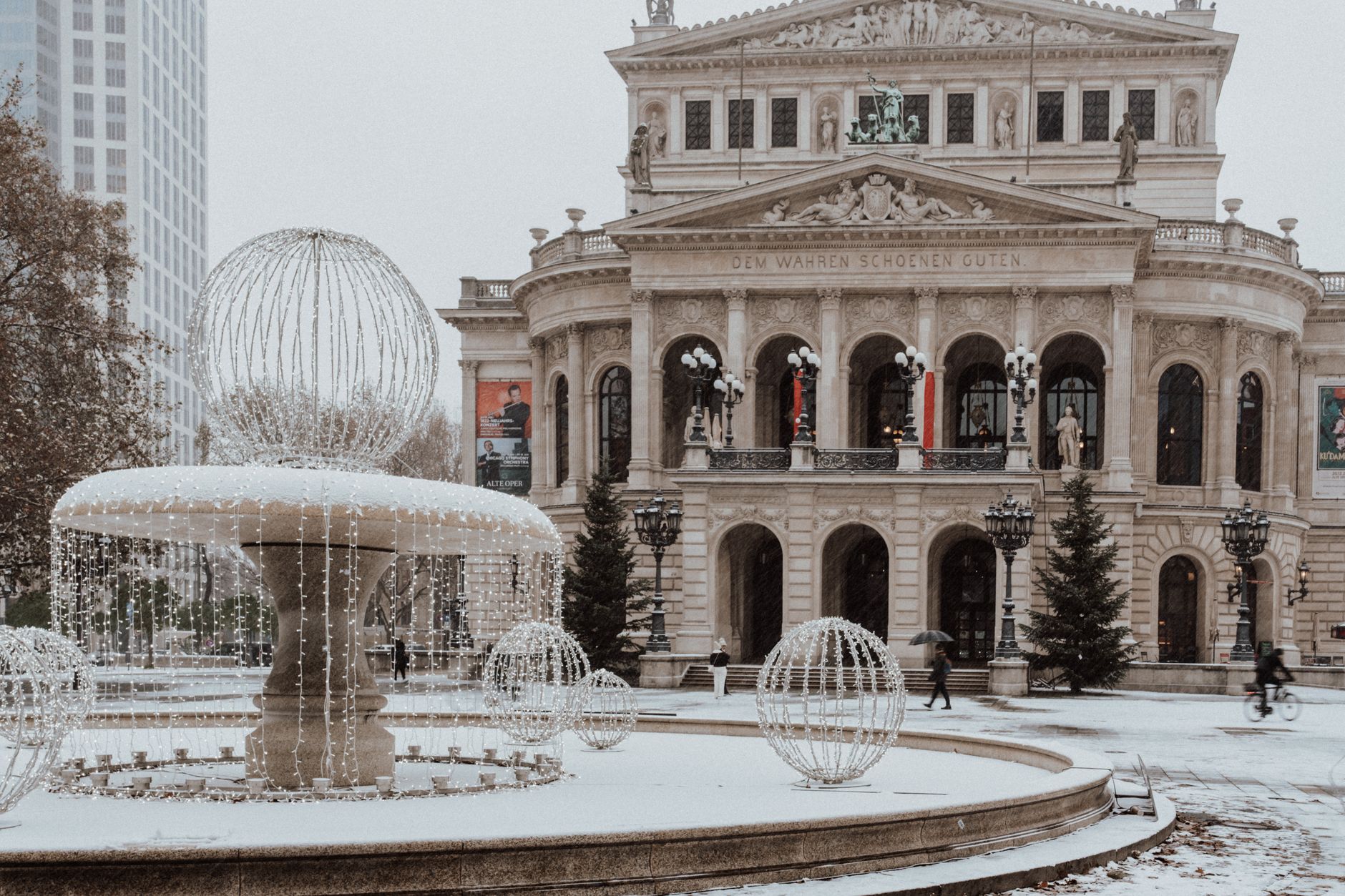
Alte Oper Frankfurt: Why the Old Opera House Has No Opera
The Alte Oper on Opernplatz has been a concert hall, not an opera house, since 1981: its history from the 1880 opening through decades as a ruin to the rebuild, what's on today, how tickets work and what the square in front has to offer.
Katharina Vogt25 September 2026
Attractions
Oper Frankfurt: Tickets, Cheap Seats and the Building's Future
Frankfurt's opera house on Willy-Brandt-Platz: why critics have named it Opera House of the Year eight times, how tickets and price categories work, how to get in for €15 — and what is going to happen to the building.
Katharina Vogt25 September 2026
Attractions
Frankfurt Cathedral: Election Chapel, the 328-Step Tower and the Dommuseum
Frankfurt's Kaiserdom St Bartholomew's, where kings were elected and emperors crowned: what to see inside, 2026 opening hours and prices for the cathedral tower (66 metres, 328 steps), the Dommuseum in the cloister and the tower-keeper's rooms.
Katharina Vogt25 September 2026
Attractions
Schirn Kunsthalle Frankfurt: Exhibitions, Tickets & the Move to Bockenheim
The Schirn has no collection of its own, only temporary exhibitions. What that means for planning a visit, why the Kunsthalle is sitting in an old printing works in Bockenheim until 2028, prices, opening hours and an honest comparison with the Städel and the MMK.
Katharina Vogt24 September 2026