Alte Oper Frankfurt: Why the Old Opera House Has No Opera
The name has been sending visitors the wrong way for decades: nobody sings Verdi on stage at the Alte Oper. A local explains how the opera house that became Germany's most beautiful ruin turned into a concert hall — and how young people get in for €10.

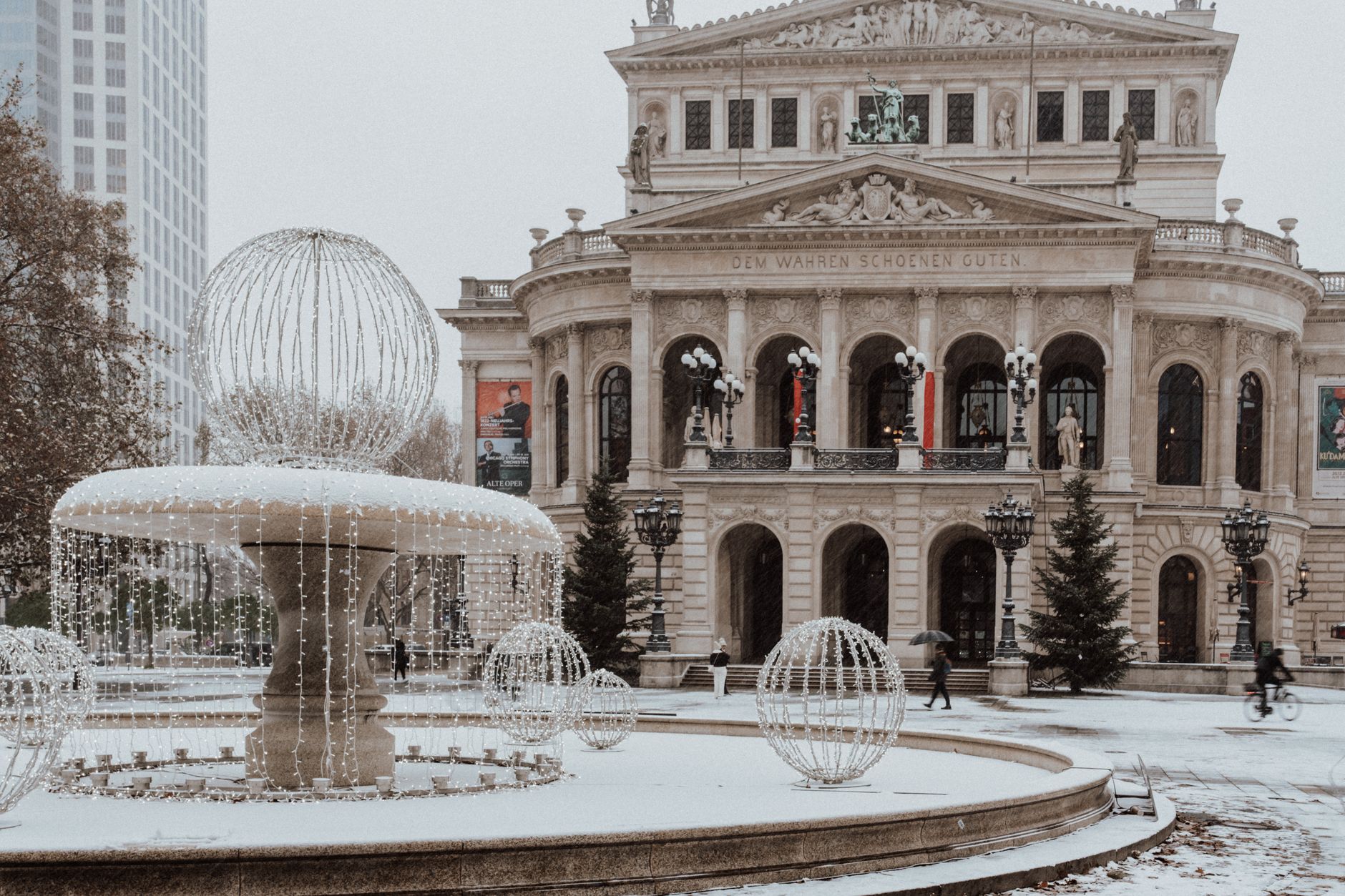
There’s one sentence I have heard in Frankfurt more often than any other cultural tip: “We went to the opera last night — well, the Alte Oper, but there wasn’t actually any opera on.” Quite. The grandest building in the city centre, the sandstone palace with a winged horse on its roof, has “opera” in its name and has been a concert and conference hall since 1981. Orchestras, pianists, jazz bands and cabaret acts perform here; congresses meet and companies throw parties. A staged opera with sets and chorus you will not see.
The actual Oper Frankfurt performs about a kilometre further south on Willy-Brandt-Platz, in a glass building from the sixties. How to get tickets there and what’s going to happen to that building is in my piece on Oper Frankfurt tickets and cheap seats. This one is about the other building — and why the “Alte”, the “old”, in its name explains more than you’d think.
1880: an opera house built on civic pride
Frankfurt had no prince to build it a court theatre. So the push came from its citizens: at the end of 1869, 67 wealthy Frankfurters founded a supporters’ association and raised 480,000 guilders within weeks. The house went up on the site of the old town fortifications, designed in neo-Renaissance style by the Berlin architect Richard Lucae. He never saw it finished — Lucae died in 1877 with only the shell complete, and Edgar Giesenberg completed the interior to his plans. It opened on 20 October 1880 with Mozart’s Don Giovanni, with Emperor Wilhelm I in attendance.
Above the entrance the inscription still reads “Dem Wahren Schönen Guten” — to the true, the beautiful, the good — a nod to Goethe. The bill, though, which ended at a little over 6.8 million marks, landed largely on the city, and the dialect poet Adolf Stoltze duly wrote his own version: “Dem Wahre, Scheene, Gute — die Berjerschaft muss blute” — the citizens must bleed. I love that rhyme, because it shows Frankfurt has always been proud of and exasperated by its showpieces in equal measure.
”Germany’s most beautiful ruin”
In a heavy air raid on 22 March 1944 the opera house was hit and burned out. What remained was a roofless façade that stood in the middle of the city for more than three decades. The opera did not go back. On 23 December 1951 it opened a new house with Die Meistersinger on what was then Theaterplatz, today’s Willy-Brandt-Platz. So the old building’s role had been handed on before anyone had decided its future.
And that future hung in the balance for a long time. The shell became known as “Germany’s most beautiful ruin” — a compliment with a sting in its tail. In 1965 Rudi Arndt, then Hesse’s economics minister, is said to have offered a million for the dynamite to anyone who would blow the thing up. He later denied saying it, but never shook off the nickname “Dynamit-Rudi”.
Against him stood a citizens’ movement. The Aktionsgemeinschaft Opernhaus, founded in 1964, raised about 15 million Deutschmarks in donations by the time the building reopened, and is regarded as the largest citizens’ initiative in West Germany’s cultural history. It saved the building — but not as an opera house. With the opera long since settled elsewhere, the ruin was rebuilt from 1976 as a concert and conference centre.
28 August 1981: Mahler instead of Mozart
On 28 August 1981 — Goethe’s birthday — the Alte Oper reopened with Mahler’s Eighth Symphony, in the presence of Federal President Karl Carstens. The exterior was faithfully reconstructed; inside, it is a modern concert building. On the roof, Pegasus is back at the front, recreated in 1981 by Georg Hüter after the original; at the rear stands a panther quadriga that originally came from the playhouse opened in 1902. When you’re on Opernplatz, walk once round the building to see both.
That settled the naming question for good: it is called the Alte Oper because it is the old opera house, not because opera is performed there. That the opera’s own orchestra plays here regularly doesn’t make things any simpler — more on that in a moment.
What’s on at the Alte Oper today
There are two main halls. The Großer Saal seats about 2,450 on four levels, panelled in mahogany, with a Karl Schuke organ from 1981. The Mozart Saal, with just over 700 seats, is the room for chamber music, new music and conferences. It is currently getting new acoustics: using Müller-BBM’s “Vivace” system and a Fraunhofer research project in which artificial intelligence is to steer the hall’s acoustics, around two years of data have been gathered, and the system is due to go live at the start of the season in September 2027. The hall is not closed in the meantime.
In all, the house says it hosts more than 460 events a year and close to half a million visitors (as of 2026). Markus Fein has been Intendant since summer 2020. The key thing for you as a visitor: not every concert comes from the same promoter. Alongside the Alte Oper’s own programme, the main players are Pro Arte and the Frankfurter Museums-Gesellschaft. The latter’s Museum Concerts are the symphony series of the Frankfurter Opern- und Museumsorchester — the orchestra of the Oper Frankfurt, of all things. Ten programmes a season, each on a Sunday at 11am and a Monday evening in the Großer Saal. So if you’re set on hearing “the opera orchestra at the Alte Oper”, you can. Just without the opera.
Beyond that there’s jazz, world music, family concerts, cabaret and shows. The programme turns over so fast that I won’t name individual dates here; check the house calendar before you travel.
Tickets: the promoter sets the price
The Alte Oper box office is right on Opernplatz, open Monday to Friday 10am–6.30pm and Saturday 10am–2pm, closed on Sundays. The ticket hotline is +49 69 1340 400, and online sales run through Frankfurt Ticket RheinMain. The final price includes the ticket itself, service and booking fees — and an RMV component, because here too your ticket is a travel pass for the journey there and back anywhere in the RMV network, from five hours before the start until services end, in second class (as of 2026).
It gets cheap if you’re young or in education — and spontaneous. From an hour before the start, the evening box office sells remaining tickets at fixed prices, and both price and eligibility depend on the promoter (as of 2026):
- Alte Oper’s own events: €15 for school pupils, students and trainees under 25, volunteers, the unemployed and holders of the Frankfurt-Pass and Kulturpass.
- Pro Arte concerts: €20 for pupils and students up to 27 and similar groups.
- Museum Concerts: €9 for anyone up to 27, €18 for anyone 65 and over — for remaining seats in categories 3 to 6.
Easier to plan is the “Under 25 – 10 Euro” scheme: everyone up to and including 25 gets Alte Oper concert tickets for €10, and that’s in advance booking. Everyone else pays the regular price, which varies widely by programme and seat. An evening with an international orchestra in the Großer Saal for €10 or €15 is one of the best cultural deals in the city, and I remember from my student days that it doesn’t always work at the evening box office for the big names, but almost always does for less famous programmes.
Behind the façade: guided tours
If you’d like to see the building without a concert, book a house tour. It takes about 90 minutes, includes rooms not normally open to the public, and costs from €12.50 (as of 2026). Public tours run only on selected dates; groups of up to 20 can book their own. For me the tour is worth it mainly for the story of the rebuild: afterwards you understand how much of what looks like 1880 actually dates from the late seventies.
Opernplatz: fountain, Fressgass and a tower
The Alte Oper doesn’t simply sit on a street; it commands a square. In front of the façade splashes the Lucae fountain, and on warm evenings students, office workers and tourists sit on the steps and the fountain’s rim. Right next door rises the Opernturm, one of Frankfurt’s younger office towers — a contrast I enjoy every time. Heading east runs the Fressgass, officially Große Bockenheimer Straße, lined with restaurants and delis, towards the Hauptwache, from where the Zeil is just a few steps on. How to turn that walk into a shopping afternoon is covered in my guide to shopping in Frankfurt. In my list of Frankfurt’s 15 top attractions, the Alte Oper is a fixed stop for precisely this reason: it is the hinge between the Westend, the banking district and the city centre.
Incidentally, the plot at Opernplatz 2, opposite the Alte Oper, was one of the options the city examined for the new drama theatre. It chose otherwise — but for a while the idea that Frankfurt’s theatre might return to this square was genuinely on the table.
Getting there and timing
U-Bahn lines U6 and U7 stop at Alte Oper station, right on the square, and your concert ticket covers the fare. If you’re driving in from the surrounding region, the most relaxed option is to leave the car at a park-and-ride on the city’s edge and take the U-Bahn in; which sites work best is set out in this guide to park and ride in Frankfurt. From Wiesbaden the trip is short enough for a weeknight concert — you can look up the distance and drive time from Wiesbaden to Frankfurt in advance.
A tip for people in transit: the 11am Sunday concert fits surprisingly well into a long layover. The S-Bahn gets you from the airport to Hauptwache in well under half an hour, and from there you walk along the Fressgass to Opernplatz. Whether the outing works with your connection is easier to judge with this checklist for a long layover at Frankfurt Airport. With luggage and little time, a pre-booked car is the calmer choice; what an airport-to-city transfer costs is compared by our partner site.
When I show visitors the Alte Oper, I stand them in front of the fountain first and tell them the dynamite story. Then we go in, and usually there’s a rehearsal or a conference on, and nobody is singing. That’s the building in a sentence: an opera house that kept its name after handing over its job — and has long since made a better life out of the new one than it ever did out of the old.
Keep reading
Attractions
Oper Frankfurt: Tickets, Cheap Seats and the Building's Future
Frankfurt's opera house on Willy-Brandt-Platz: why critics have named it Opera House of the Year eight times, how tickets and price categories work, how to get in for €15 — and what is going to happen to the building.
Katharina Vogt25 September 2026
Attractions
Theatre in Frankfurt: Schauspiel, English Theatre, Tigerpalast and More
Frankfurt's stages beyond the opera: the Schauspiel Frankfurt with English surtitles, the English Theatre back in the Gallileo tower, variety at the Tigerpalast, plus the Volksbühne and the Mousonturm, with 2026/27 prices, box-office hours and what works if you speak no German.
Katharina Vogt25 September 2026
Attractions
Jewish Museum Frankfurt: Tickets & Opening Hours
The Jewish Museum Frankfurt across two sites — the Rothschild-Palais on the Museumsufer and the Museum Judengasse over the old ghetto. The WE ARE NOW permanent exhibition, prices, opening hours and how to get there (as of 2026).
Katharina Vogt19 June 2026
Attractions
Paulskirche Frankfurt: Cradle of German Democracy, the Peace Prize and What to See Inside
Frankfurt's Paulskirche (St Paul's Church), where Germany's first freely elected parliament sat in 1848–49: the foyer, the assembly hall and Grützke's mural, opening hours (daily 10am–5pm, free), the 2026 Peace Prize for Philippe Sands, and where the refurbishment and House of Democracy really stand.
Katharina Vogt25 September 2026