Oper Frankfurt: Tickets, Cheap Seats and the Building's Future
One of Europe's finest opera companies performs in a building the city plans to knock down. A local explains how to get good seats cheaply, where to sit for the English surtitles, and why the demolition crews won't be turning up any time soon.

Walk across Willy-Brandt-Platz on your first evening in Frankfurt and you won’t see an opera house at all. You’ll see a 120-metre glass frontage from the early sixties, and behind it, suspended below the foyer ceiling, a drift of golden clouds. That is the Oper Frankfurt. No columned portico, no sweeping staircase, no chandelier theatrics — and yet it is one of the houses people in the opera world, from Zurich to Munich to London, talk about with real respect. I have been going for years, mostly in cheap seats, occasionally in expensive ones, and what I have learnt is this: if you know the quirks of the place, you get an evening here for a fraction of what it would cost you in most European capitals.
One thing first, because it sends visitors to the wrong door every week. The grand Alte Oper on Opernplatz is not the opera. It was until the war; today it is a concert hall. If you want Tosca or Turandot, you go to Willy-Brandt-Platz. How the two swapped roles is a story in itself, and I tell it in my piece on the Alte Oper Frankfurt.
Why the critics keep choosing this house
Every year at the end of the season, the German trade magazine Opernwelt polls international critics on which company had the best season. The Oper Frankfurt has now won that title, Opera House of the Year, eight times, most recently three years running: 2022, 2023 and 2024. Sources don’t list the earlier winning years consistently, incidentally — but the total of eight and the run to 2024 are not in dispute. In 2025 the title went to Zurich, and in the poll published only today, 25 September 2026, to the Staatstheater Mainz. Frankfurt hardly went home empty-handed, though: its general music director, Thomas Guggeis, was voted Conductor of the Year, and the critics’ Orchestra of the Year was the one in the Frankfurt pit.
What is behind the run? Bernd Loebe has been Intendant since 2002, and he leans on something that has become rare in the age of jet-set stars: a strong resident ensemble you get to hear over several seasons in changing roles, set against a programme that places repertoire staples next to rarities few other houses dare. The 2026/27 season shows the pattern well: eleven new productions, 14 revivals, eight song recitals. It opened on 22 August with Puccini’s Turandot; on 13 September came Tchaikovsky’s seldom-staged Mazeppa (about four hours with two intervals, sung in Russian with German and English surtitles); Verdi’s Un ballo in maschera follows in December, and June 2027 brings a world premiere, Ronchetti’s Battaglia.
The orchestra itself, the Frankfurter Opern- und Museumsorchester, does not only play in the pit. Its symphony series, the long-established Museum Concerts, takes place in the Alte Oper — a detail that completes the naming muddle between the two buildings rather neatly.
A glass house with a fire scar
Today’s building is a so-called double theatre: since 1963 the opera and the Schauspiel Frankfurt drama company have shared one building and one foyer behind that glass wall. The golden clouds are the work of the Hungarian artist Zoltán Kemény, and the house also holds Marc Chagall’s 1959 painting Commedia dell’arte, after which the Chagall Saal is named. The opera had already moved to this site in 1951, because its old home on Opernplatz had burned out in the war.
In the early hours of 12 November 1987 an arsonist set the fly tower alight and it burned out completely. For three years the opera played on the drama company’s stage while the actors decamped to the Bockenheimer Depot, a former tram shed by the Bockenheimer Warte that has stayed on as a second venue ever since. So if your ticket says “Bockenheimer Depot”, don’t head for Willy-Brandt-Platz: take the U4, U6 or U7 to Bockenheimer Warte (Carlo-Schmid-Platz 1).
The opera house itself seats roughly 1,370: 22 rows in the stalls and three circles (as of 2026).
Frankfurt opera tickets: categories, box offices, fees
The pricing is simpler than it looks. Each performance is assigned a price category, shown against the date in the season calendar — a premiere costs more than the twelfth performance of the same production, a recital less than a big Verdi night. You see the actual prices by clicking on the date. Quoting one blanket range would be misleading; the student prices do give you a sense of scale, though: at 50 per cent off, the opera itself says they run from €8 to around €60 for the premium seats (as of 2026).
More important than the price is where you buy:
- Directly from the opera — its own web shop, by phone on +49 69 212 49 49 4 (Mon–Fri 9am–7pm, Sat and Sun 10am–2pm), or at the advance box office on Willy-Brandt-Platz (Mon–Fri 10am–6pm, Sat 10am–2pm). There is no booking fee.
- Through outside ticket agencies — they add 12.5 per cent. There is no reason to pay it.
On the day itself you can book online until 75 minutes before curtain up. The evening box office opens an hour beforehand, as do the doors.
And then the detail that pays for your journey: an opera ticket doubles as an RMV travel pass across the whole regional network, from five hours before the performance until services end for the night, in second class. The opera names two exceptions: free tickets don’t count, and — this is the trap — print-at-home tickets (“Ticketdirect”) are not valid for travel. If you are coming in by S-Bahn from Wiesbaden or Darmstadt, have the tickets posted (€3) or held for collection. Why that rule is worth more in Frankfurt than you might think is something I worked through in my guide to Frankfurt public transport tickets and fares.
Getting in cheaply: the routes I actually use
This is where the Oper Frankfurt becomes genuinely generous, and almost no visitor knows:
- Under 30 and a student or trainee: 50 per cent off all regular tickets, international students included, premieres excepted.
- Junge OpernCard: €10 a year for anyone under 30. It gets you the best remaining seats in category III at the evening box office for €15, plus one companion under 30 at the same price. Go more than once a year and it has paid for itself on the first night.
- With children: under the heading “Opera for Families”, an adult paying full price can request up to three free tickets for children and young people under 19 (as of 2026). For a family, it is the best rule in the building by a distance.
- Regulars: the OpernCard at €95 a year gives 30 per cent off, except for premieres and special events.
- Kulturpass holders: €3 per performance.
And if you’re over 30 and none of that applies? Choose a midweek revival rather than a Saturday premiere. Same ensemble, different price, and you hear the production once it has bedded in. That is the most honest tip in this piece.
Where to sit — and where not to
The opera is refreshingly candid about this. From the side seats in the circles, and from the ends of row 9 and further back in the stalls, you don’t see the full depth of the stage, and there is less legroom upstairs. If you’re tall, take an aisle seat.
For English speakers the key point is the surtitles. Nearly every production has German and English surtitles, but the English ones run only on the large monitor above the stage, to the right of the German. If you want to follow in English, don’t sit at the far left. The centre of the stalls and the middle of the circles are the safe bet on every count.
There is no dress code. I see evening gowns next to jeans — more of the former at premieres, more of the latter midweek. Nobody looks twice.
The evening around it
U-Bahn lines U1 to U5 and trams 11 and 12 stop right outside at Willy-Brandt-Platz. If you drive, the opera points you to the “Am Theater” underground garage beside the building, which has an evening rate from 5pm; the alternative is the Untermainanlage car park two or three minutes away. How those compare with the rest of the city centre is laid out in this rundown of central Frankfurt car parks. If you are driving in from Rheinhessen, it’s worth checking the real drive time between Mainz and Frankfurt first — though with an opera ticket in your pocket, the S-Bahn is the cheaper option.
Interval drinks and snacks can be ordered in advance and will be waiting at a reserved table in the Wolken (Clouds) foyer — worth its weight in gold in the first-interval crush. Afterwards most people don’t linger in the building but move on; my ideas for that are in my guide to Frankfurt at night. After a four-hour Mazeppa, the last train doesn’t always go where your hotel is, and then it helps to know what a taxi ride across Frankfurt costs. If you fly out the next morning, bear in mind that the airport reshuffled itself in 2026 — Terminal 2 is closed, Terminal 3 is new — so check which terminal your airline now uses before you set off.
Demolition, new build, 2040: what happens to the building
The building is in poor shape; nobody disputes that. The question for years has been what to do about it, and the answer has firmed up in several steps. Here is the position as of September 2026, as precisely as the record allows:
- January 2020: the city council rejected refurbishment. It would have cost barely less than new buildings and forced both companies out for five or six years. New construction was decided.
- 2023: the opera is to be rebuilt on Willy-Brandt-Platz, on city-owned land.
- December 2024: for the drama company, the “Kulturmeile” (culture mile) option won — a separate new playhouse on Neue Mainzer Straße, on the Helaba and Frankfurter Sparkasse site between the street and the green ring of the Wallanlagen. The framework agreement was signed in May 2025.
- 2024 to 2026: an interim campus on Gutleutstraße was acquired, a storage and logistics centre in Sossenheim was settled, and in February 2026 an international planning team was hired for the masterplan.
- 5 March 2026: the city council voted to set up the Bühnenbaugesellschaft Frankfurt mbH, a wholly city-owned company to manage the demolition, both new buildings and the interim operation.
The sequence is clear. The new playhouse comes first and is meant to serve the opera as its temporary home. Then the double theatre comes down and the new opera house goes up on the same spot. What is not settled: a demolition date, a construction start, an opening year. The architectural competition is meant to launch in 2026/27 ideally, but hasn’t yet. Reports give 2040 as the target for both new buildings, with construction expected to begin in the 2030s — there is no binding timetable.
For your visit, that means performances in the old house carry on as normal for years yet. If you want to see the glass wall and its golden clouds before they become history, you have time — just don’t leave it indefinitely.
When friends ask me how to plan their first night here, my answer is always the same: a midweek revival, bought straight from the opera’s web shop and posted so it works as a travel pass, a seat in the middle of the stalls or the front of the first circle, and interval drinks ordered ahead. You’ll understand quite quickly why the critics have so often put this unassuming glass box at the very top.
Keep reading
Attractions
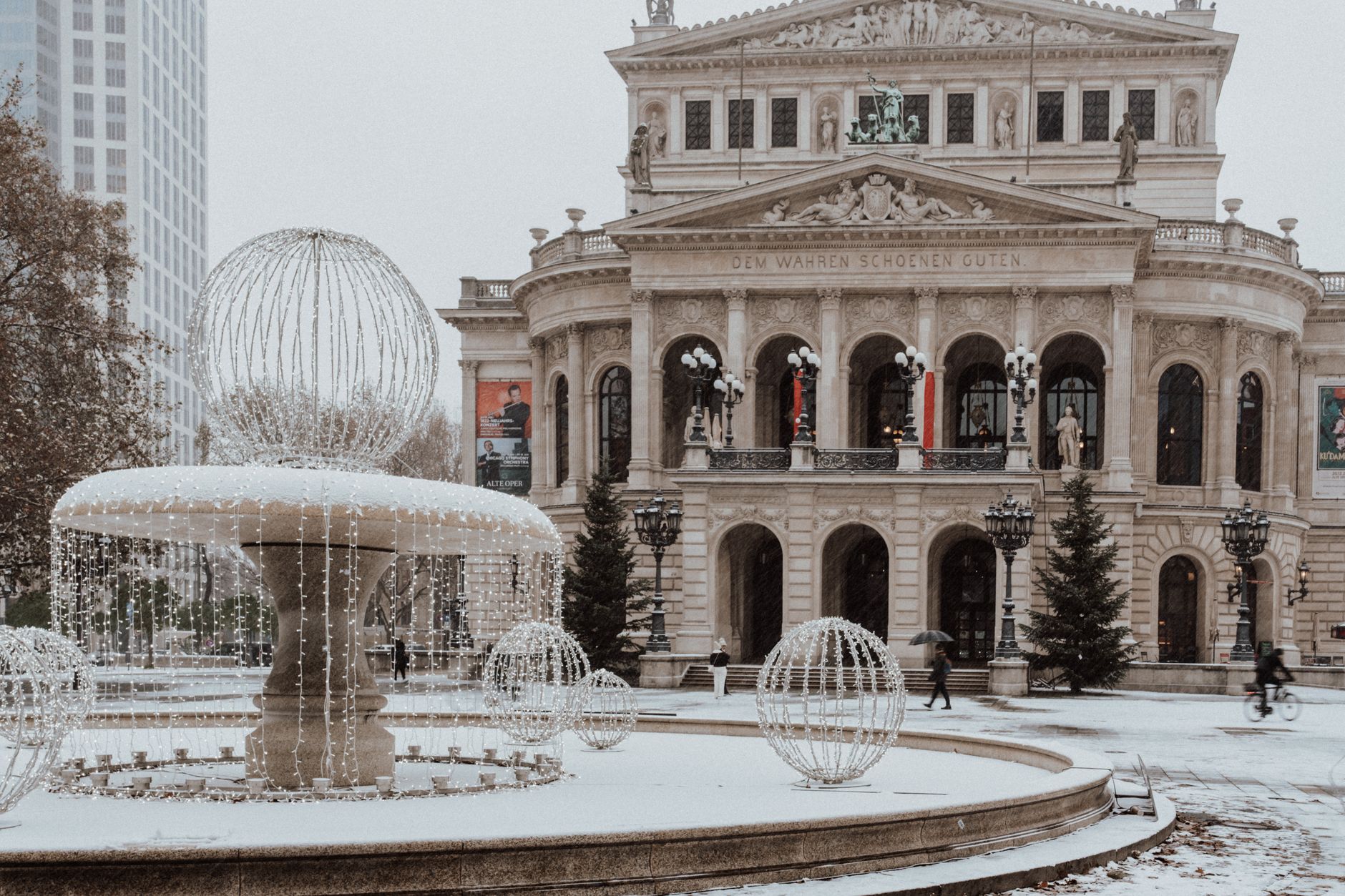
Alte Oper Frankfurt: Why the Old Opera House Has No Opera
The Alte Oper on Opernplatz has been a concert hall, not an opera house, since 1981: its history from the 1880 opening through decades as a ruin to the rebuild, what's on today, how tickets work and what the square in front has to offer.
Katharina Vogt25 September 2026
Attractions
Theatre in Frankfurt: Schauspiel, English Theatre, Tigerpalast and More
Frankfurt's stages beyond the opera: the Schauspiel Frankfurt with English surtitles, the English Theatre back in the Gallileo tower, variety at the Tigerpalast, plus the Volksbühne and the Mousonturm, with 2026/27 prices, box-office hours and what works if you speak no German.
Katharina Vogt25 September 2026
Attractions
Paulskirche Frankfurt: Cradle of German Democracy, the Peace Prize and What to See Inside
Frankfurt's Paulskirche (St Paul's Church), where Germany's first freely elected parliament sat in 1848–49: the foyer, the assembly hall and Grützke's mural, opening hours (daily 10am–5pm, free), the 2026 Peace Prize for Philippe Sands, and where the refurbishment and House of Democracy really stand.
Katharina Vogt25 September 2026
Attractions
Schirn Kunsthalle Frankfurt: Exhibitions, Tickets & the Move to Bockenheim
The Schirn has no collection of its own, only temporary exhibitions. What that means for planning a visit, why the Kunsthalle is sitting in an old printing works in Bockenheim until 2028, prices, opening hours and an honest comparison with the Städel and the MMK.
Katharina Vogt24 September 2026