Nordend, Frankfurt: Gründerzeit Streets, Oeder Weg and the Holzhausenpark
Some 55,000 people on four and a half square kilometres, stucco façades, a moated manor house behind the Oeder Weg and a market that turns into the neighbourhood's Friday meeting point: why the Nordend is where Frankfurters move when they can.

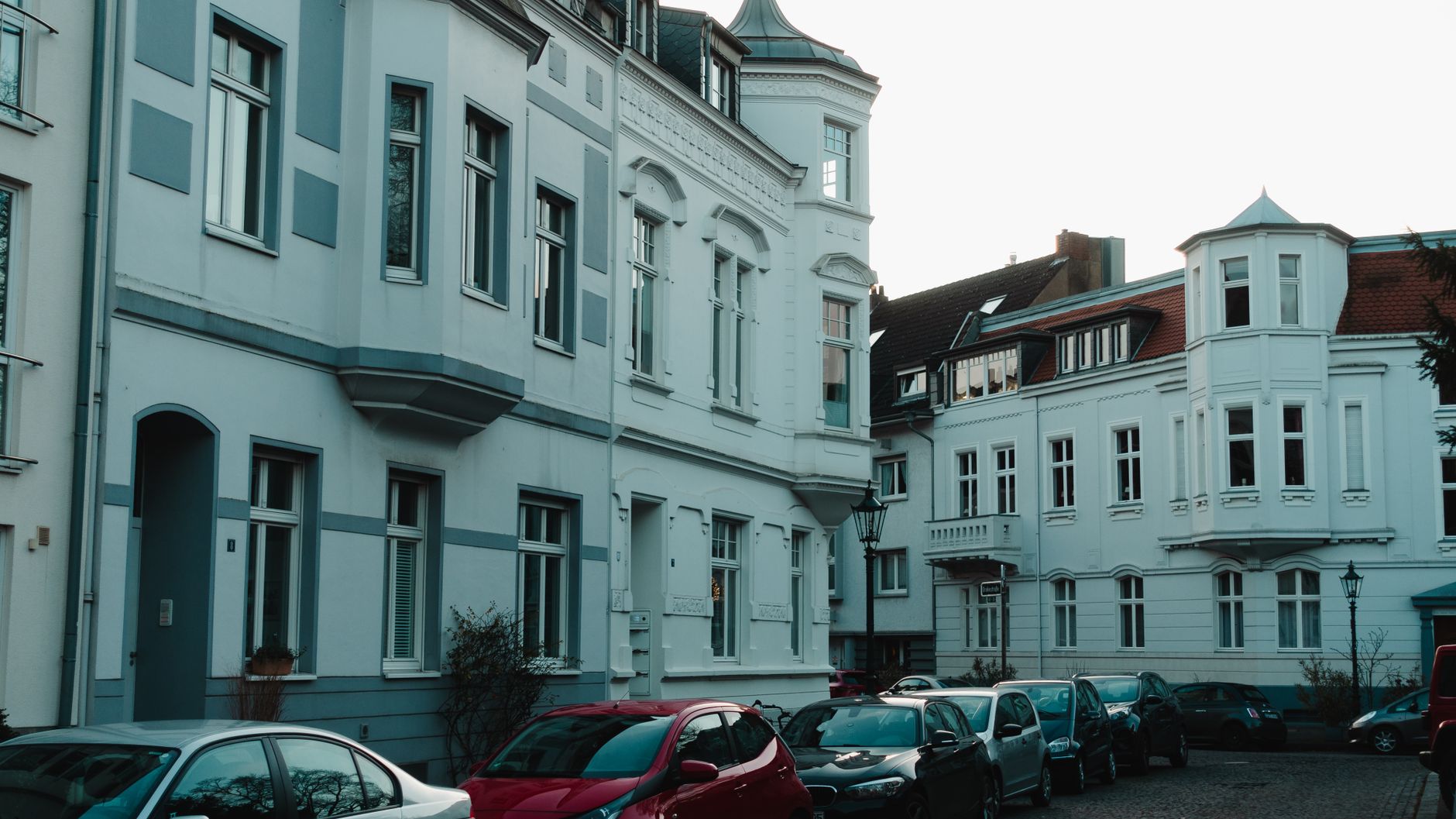
I live in the Nordend, and in Frankfurt I rarely say so without someone sighing. The district has a reputation: beautiful old buildings, good cafés, not a flat to be had. All three are true. What the reputation leaves out is how little the Nordend tries to impress visitors. There is no landmark to tick off, no square where the coaches pull up. What there is instead is a set of streets where everyday Frankfurt life is lived more densely than anywhere else in the city, and that is exactly why it is worth half a day of your trip. My own routes through the quarter almost always run through the same places: the Oeder Weg, Glauburgstraße, the Holzhausenpark and, on Fridays, the market on Friedberger Platz.
From country estates to Gründerzeit terraces
The Nordend sits directly north of the Anlagenring, the green ring around the old city centre, and runs up to the main cemetery. The Eschersheimer Landstraße separates it from the Westend to the west; to the east it borders Bornheim and the Ostend. The name appeared around 1850 and simply meant the northernmost extension of the city. Before that this was farmland: royal farmsteads in the Middle Ages, later fortified estates belonging to Frankfurt’s patrician families. Their names are on today’s street signs, from Glauburgstraße to Holzhausenstraße, and in two places you can still see something of those estates, of which more below.
The district got its face in the Gründerzeit, the building boom of the late nineteenth century. That is when the unbroken rows of four-storey apartment houses on red sandstone bases went up, along with the broad streets you walk down today. A good part of it survived two world wars, and the city protects it deliberately: a conservation statute for the Nordend is meant to secure the townscape of this nineteenth-century northern extension. It doesn’t forbid change, but it makes every project subject to approval, down to window shapes and dormers. That’s why whole streets look so remarkably of a piece.
With 55,121 residents at the end of 2025, the Nordend is Frankfurt’s second most populous district after Sachsenhausen, and at around 11,900 people per square kilometre one of its densest. Officially it splits into Nordend-West and Nordend-Ost, divided by the Friedberger Landstraße. Nobody talks like that in daily life; you simply live “im Nordend”. How it compares with the city’s other quarters is set out in my big overview of Frankfurt’s districts.
The Oeder Weg: a street that reinvented itself
The Oeder Weg is 1,325 metres long and runs north from the Anlagenring at the Eschenheimer Tor to the Eckenheimer Landstraße. It takes its name from the isolated farmsteads it once led out to, among them the estates of the Holzhausen, Glauburg and Stalburg families. The southern half is the shopping street of the western Nordend, with shops, cafés and restaurants; the northern half is purely residential.
What makes the Oeder Weg special now is a traffic experiment that stayed. Since 2021 bicycles have had priority here: red markings on the carriageway, planters and benches where cars used to park, more room for outdoor tables. A so-called modal filter at the junction with Holzhausenstraße forces cars to turn off, while cyclists and pedestrians carry straight on. The Frankfurt University of Applied Sciences monitored the project, and its final report in April 2024 found car traffic roughly halved. In 2024 the local district council, Ortsbeirat 3, voted by a narrow margin, 10 of its 19 members, to make the scheme permanent. I was sceptical when the first planters appeared. These days I would rather sit here on a summer evening than on any other shopping street in Frankfurt, because you can hold a conversation again without shouting over the traffic.
My favourite address is a converted petrol station: The Station at Oeder Weg 57, a small brewery with a beer garden. It used to be the BrauStil brewery, which closed in spring 2024; Kai Greinus, who had been part of that team, took the place over. There are house beers, up to six guest taps, wine from small growers and pizza from the neighbours. It is open Tuesday to Thursday 5–10pm, Friday until 11pm, Saturday 3–11pm and Sunday 4–10pm, closed on Mondays (as of 2026). It’s a good 400 metres from the Musterschule U-Bahn stop.
Glauburgstraße: cake in the morning, apple wine at night
A few minutes’ walk east of the Oeder Weg, Glauburgstraße runs from west to east, and two of its addresses sum up the Nordend for me. The Glauburg Café at number 28 is a family-run, organic-certified neighbourhood café: bread, spreads and cold cuts in the morning, soups, salads and bowls at lunch, home-made cakes and tarts in the afternoon. It opens daily from 9am to 5pm (as of 2026), and booking is a good idea. For more of the district’s breakfast addresses, see my guide to breakfast and brunch in Frankfurt.
Further west, at Glauburgstraße 80, is Zur Stalburg, an apple-wine tavern that has been going since 1879 and sits within the walls of an old moated manor. There has been a building on this spot since 1415; in the late fifteenth century it was bought by Claus Stalburg, then one of Frankfurt’s wealthiest patricians. The kitchen serves classic Frankfurt food, and it is open Monday to Saturday noon to 11pm and Sunday until 10pm (as of 2026). The tavern’s former dance hall has been home since the late 1990s to the Stalburg Theater, founded by the journalist Michael Herl. You sit at bistro tables, the programme runs from cabaret and jazz to the company’s own plays, and the box office opens at 6pm on performance days. The theatre also runs an open-air festival, “Stoffel”, in the Günthersburgpark; in 2026 it ran from 30 July to 18 August with music, dance, a flea market and a children’s programme.
For both, take the U5 to Glauburgstraße; each is less than 200 metres from the stop.
The Holzhausenpark and its moated manor house
Walk north along the Oeder Weg and you come to a wrought-iron gate from the late eighteenth century. It marks the old boundary of the Holzhausen estate, and behind it an avenue of chestnut trees, planted around 1910, leads to the loveliest building in the district: the Holzhausenschlösschen. The patrician Holzhausen family held this land, then known as the “Holzhausen Oed”, from the Middle Ages. An earlier moated castle on the site was destroyed in the siege of Frankfurt in 1552. The present Baroque manor was built between 1727 and 1729 to plans by Louis Remy de la Fosse as a summer residence for Johann Hieronymus von Holzhausen, and you reach it over a three-arched stone bridge across the pond.
The last male heir, Adolph von Holzhausen, gave the park and the house to the city. In 1912 and 1913 the grounds were turned into a public park and opened to everyone. Today the Holzhausenpark covers 3.5 hectares of English-style landscape garden, one that Hans Thoma was already painting in 1880. Since 1989 the house has been home to the Frankfurter Bürgerstiftung, a civic foundation that stages concerts, jazz nights, readings and debates there (Justinianstraße 5). A warning for photographers: since autumn 2025 the façade, windows and roof have been undergoing a thorough restoration ahead of 2027, when the building marks 300 years in its present form. Expect scaffolding.
The nearest station is Holzhausenstraße (U1, U2, U3, U8), three minutes from the Hauptwache and just under 400 metres from the house. If you want more green afterwards, the Grüneburgpark and the Günthersburgpark both feature in my walk through Frankfurt’s parks and riverbank, which also explains why the Günthersburgpark in Nordend-Ost is simply overrun on fine days.
The lower Berger Straße and the Bethmannpark
The Berger Straße starts at the Friedberger Anlage, and its first stretch, up to Höhenstraße, belongs to the Nordend; only after that does Bornheim take over. Down here it is more urban, with small boutiques and bars around the U4 station at Merianplatz with its green tiles. The upper end, with the Uhrtürmchen, the market and the apple-wine taverns, is covered in my portrait of Bornheim and the Berger Straße, so I won’t repeat it here.
Right at the start of the street is the Bethmannpark, 3.1 hectares between Friedberger Landstraße, Berger Straße and Mauerweg. Johann Philipp Bethmann bought the garden in 1783, and the city has owned it since 1941. Tucked into its south-western corner since 1989 is the Chinese Garden, the “Garden of Heavenly Peace”. From the Merianplatz U4 station you reach the north-eastern entrance; trams 12 and 18 stop at Hessendenkmal.
Fridays on Friedberger Platz
The weekly market on Friedberger Platz runs on Fridays from 10am to 8pm (as of 2026) and is operated by HFM, the city’s market company: fruit and vegetables, meat and sausages, poultry, eggs, olives, cheese, pasta and flowers. In the daytime it is simply a very good market. After work it becomes a meeting point where people from the offices and the residents stand around with a glass of wine or beer, peaceably and sociably. A tip from a neighbour: come early in the evening, bring some patience and take your rubbish with you, and the square stays what it is. Trams 12 and 18 take three minutes from Konstablerwache to the Friedberger Platz stop.
On the northern edge: cemetery, school, library
To see more of the Nordend than its cafés, take the U5 to Hauptfriedhof. The main cemetery opened in 1828 and now covers around 70 hectares. Its classical Old Portal with Doric columns was built by Friedrich Rumpf between 1826 and 1828. Arthur Schopenhauer and Theodor W. Adorno are buried here, as are Ricarda Huch and Marcel Reich-Ranicki, and so is Pauline Schmidt, the model for “Paulinchen” in Struwwelpeter. More than 900 graves are listed monuments. An afternoon here is quiet and oddly beautiful, especially in autumn.
On the way, two buildings deserve a look. At Hebelstraße 15–17 stands the Philanthropin, founded in 1804 as a Jewish school; the present building dates from 1908. The Nazis closed the school in 1942; since the 2006/07 school year it has again housed a Jewish school, the I. E. Lichtigfeld-Schule. And at the northern end of the Oeder Weg, where it meets the Eckenheimer Landstraße, stands the German National Library.
Why everyone wants to move here
What makes the Nordend the district Frankfurters move to the moment they can? For me it’s the short distances. I don’t need a car for anything: bakery, market, cinema, park, pub, all within walking distance, and the city centre a few minutes away by U-Bahn. Add a streetscape that the conservation statute shields from jarring gaps, and a neighbourhood that genuinely meets at markets, in cafés and on its squares.
The flip side is density. Green space is scarce, the parks are full on fine days, and a parking space in the Nordend is the stuff of legend. If you are driving, it helps to read up first on how resident parking, parking zones and car parks work in German city centres, and then take the U-Bahn after all.
Getting there
The Nordend has no S-Bahn, but almost everything else. The U5 runs from the Hauptbahnhof via Konstablerwache and then north, stopping at Musterschule, Glauburgstraße and Hauptfriedhof; the Hauptbahnhof to Musterschule takes six minutes. The U4 stops at Merianplatz, the U1, U2, U3 and U8 at Holzhausenstraße on the western edge, and trams 12 and 18 serve the east of the district. Arriving from the airport with luggage, you can gauge in advance roughly what a cab from Frankfurt Airport into the city costs. For the way home it helps to know how Terminal 1 and its piers A, B, C and Z fit together before you step off the train with a suitcase. And if you’d rather ride home by app after a long evening on Friedberger Platz, our colleagues have a clear explanation of how Bolt builds its fixed fares in Germany.
My Nordend Friday
When friends visit, I put the Nordend on a Friday. We start around ten with coffee and cake at the Glauburg Café, then walk down the Oeder Weg to the wrought-iron gate and along the chestnut avenue to the Holzhausenschlösschen. A loop round the park at midday, then the U5 up to the Hauptfriedhof, the Old Portal and Schopenhauer’s grave. Late afternoon we head back via Friedberger Platz for a glass of wine at a stall among the neighbours. And when it gets dark we choose between a beer at the old petrol station on the Oeder Weg and a glass of apple wine at the Stalburg.
The Nordend isn’t a district you sightsee. It’s one where, for a few hours, you pretend you live here, and in doing so work out why so many Frankfurters want to. Bring a Friday, comfortable shoes and no fixed plan, and let one street send you on to the next.
Keep reading
Neighbourhoods
Bockenheim: Frankfurt's Old University Quarter, from the Warte to Leipziger Straße
A local's portrait of Frankfurt-Bockenheim: the Bockenheimer Warte and its Thursday market, Leipziger Straße, the old university campus and the planned Kulturcampus, the Schirn in the former Dondorf printworks until around 2028, the Senckenberg and the Bockenheimer Depot, with transport tips and a walking plan (as of 2026).
Katharina Vogt25 September 2026
Neighbourhoods
Bornheim & Berger Straße: Frankfurt's Lively Quarter
Bornheim, affectionately called 'Bernem': the nearly 3-km Berger Straße, the market at the Uhrtürmchen (Wed & Sat), apple wine at Solzer and Zur Sonne, and the Günthersburgpark — a local's portrait with travel tips.
Katharina Vogt16 June 2026
Neighbourhoods
Sachsenhausen: Apple Wine, Green Sauce & Museums
A portrait of Frankfurt-Sachsenhausen: the cobbled lanes of Alt-Sachsenhausen, green sauce and its seven herbs, the Museumsufer on the Schaumainkai, Schweizer Straße and the Main — with verified tips from a local.
Katharina Vogt16 June 2026
Neighbourhoods
Frankfurt Districts: The Big Overview
From the old town and the Bahnhofsviertel via the Westend, Nordend and Bornheim to Sachsenhausen, Ostend and Höchst: the character, landmarks and visitor tips for Frankfurt's key neighbourhoods.
Katharina Vogt19 June 2026