Eintracht Frankfurt at Deutsche Bank Park: a Visitor's Matchday
60,100 places, the Bundesliga's second-largest standing terrace — and a ticket that doubles as your travel pass, provided you have activated it. A matchday in the Frankfurt city forest, from the hunt for a seat to the final whistle.

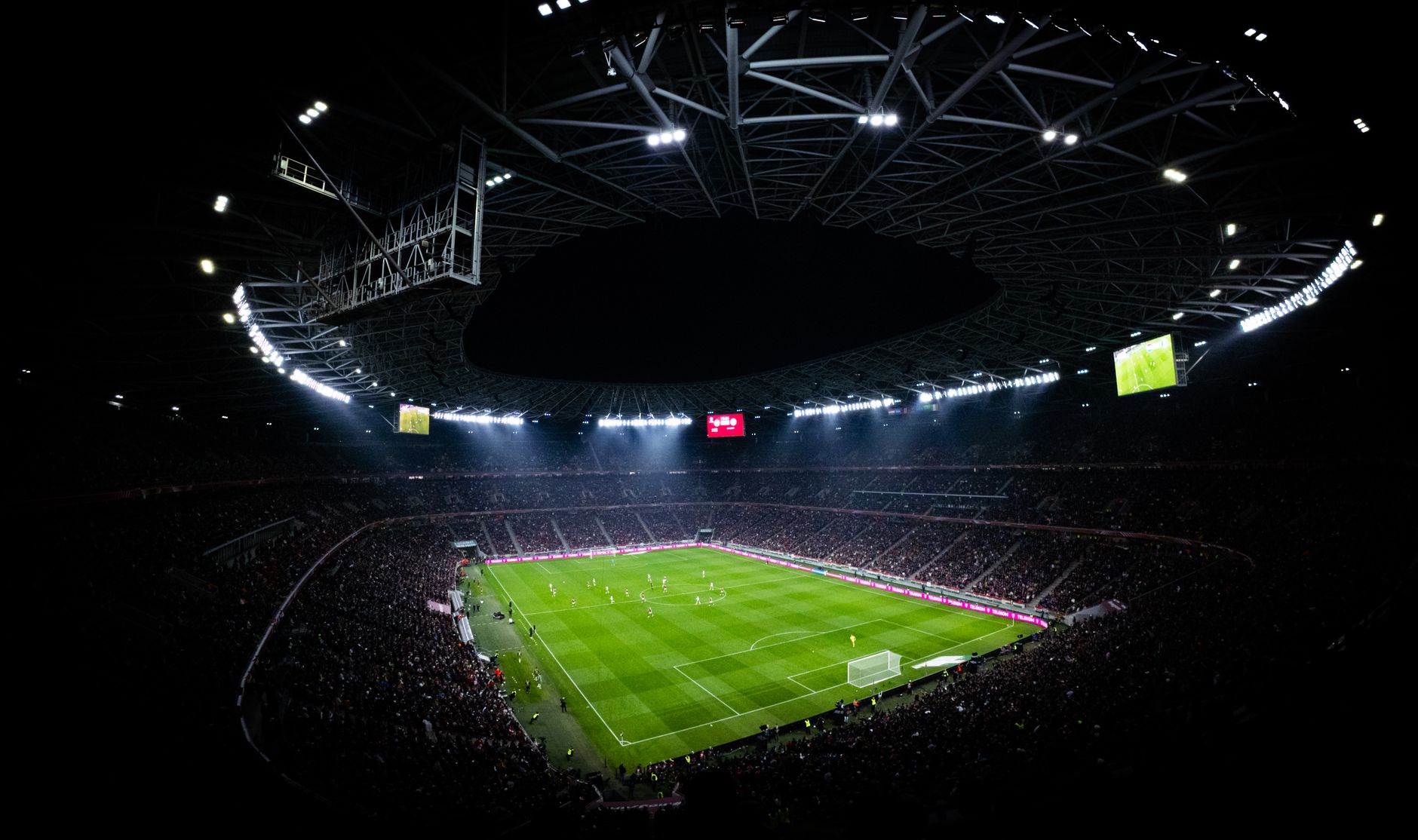
On an ordinary Tuesday, Stadion station looks like any other suburban halt: a shelter, a ticket machine, woodland behind it. Two hours before a Bundesliga home game the same platform is a funnel, with waves of people in black, white and red pouring through it, and the footpath through the city forest turns into a procession. A matchday at Deutsche Bank Park is very manageable for a visitor — it just cannot be done on impulse, because the hard part is neither the journey nor the turnstile but the ticket (as of 2026).
Buying Eintracht tickets: the routes that actually work
A season ticket is not an option for a visitor, and any that are given up go to club members first. For single-match tickets there are three routes worth knowing.
The members’ pre-sale. Eintracht members aged seven and over hold an exclusive pre-purchase right on day tickets for the men’s home matches. Membership costs adults 90.00 euros a year, children and young people aged 7 to 17 and concessions 44.00 euros, a family 160.00 euros, plus a one-off 20.00 euro joining fee (as of 2026) — which pays for itself if you come more than once a season. The step people forget is technical: your ticketing account has to be linked to the membership in the wallet of the mainaqila app, or the pre-purchase right does not apply at checkout.
The open sale. Whatever is left goes into general sale, and the club announces those dates in advance under Ticket-News. For the biggest fixtures it reserves the right to set a membership cut-off date and to allocate tickets by ballot within an application window; how many tickets one person can get depends on the match category. I deliberately quote no prices — they vary by block and by opponent.
The ticket exchange. The underrated route: a supporter who cannot use a ticket returns it through the club’s own Ticketbörse, handled officially and under the DFL’s fair-play pricing rules. The crucial detail is that there is no separate marketplace — returned places simply reappear as free seats in the normal sale, so a fixture sold out yesterday can have two singles on the Gegengerade by this afternoon. Refreshing the seating plan several times a day in the week beforehand beats looking once and giving up. Third-party resale sites I would avoid.
Reading the Eintracht fixture list before you book
The fixture list is fixed in summer; the kick-off times are not. The DFL schedules in stages, because European ties, cup rounds and international windows only firm up gradually. So the ticketing page shows near matches with a date and time, distant ones with a two- or three-day window. On 17 September 2026 the home fixtures read: SC Freiburg on 19 September at 15:30, 1. FC Köln on 16 October at 20:30, Hamburger SV on 1 November at 17:30, TSG Hoffenheim on 21 November at 15:30 — then Werder Bremen (4 to 6 December), Schalke 04 (8 to 10 January) and Bayern München (15 to 17 January) still unscheduled.
The rule that follows: if your weekend is more than six weeks away, book accommodation you can cancel free of charge, because a match pencilled in for Saturday afternoon can end up on Friday night. Add the European evenings and cup rounds, the finest dates of all here, where floodlights and a closed roof give the ground a different acoustic. For the city’s other big weekends, see my calendar of Frankfurt festivals and events.
Nordwestkurve or a seat: what your block decides
Since the 2026/27 season the ground holds 60,100 spectators, after a capacity that climbed in stages from 51,500 to 59,500; the last 600 places came from a trimmed press tribune and a more compact business area. A substantial share of that is standing: the Nordwestkurve has roughly 7,000 standing places in the lower tier, and the 2023 rebuild added 12,900 in the upper tier — close to 20,000 together, the second-largest standing terrace in the Bundesliga.
Standing there is the cheapest ticket and the most intense experience, but it is not a seat with an option to stand up. You are on your feet for two lots of forty-five minutes, you move with the block rather than independently, and for the first quarter of an hour you may be looking at the back of a flag. Anyone who wants to take photographs, follow the game tactically or bring children is better off seated on the Haupttribüne or the Gegengerade. For a first visit I would take a seat facing the curve: the choreographies and the sea of flags are arguably more impressive from across the pitch than from inside them. Note too that in international fixtures the standing areas cannot be used at all — the curve is fitted with seats, capacity drops sharply and the pricing is different.
Away supporters are housed in the eastern part of the ground — seating in blocks 19 and 21, standing in 18 and 20 — and for league matches the visiting club receives ten per cent of the capacity. If you are flying in for it, the routes through the terminals are explained in the guide to Germany’s busiest airport; allow a good hour between landing and kick-off. If you are driving in from the Rhineland for the Köln fixture, the road distance and driving time between Frankfurt and Cologne are there at a glance.
Getting to Deutsche Bank Park: your ticket is your travel pass
The address is Mörfelder Landstraße 362, 60528 Frankfurt am Main, in the city forest south of the Main. From the Hauptbahnhof, lines S7, S8 and S9 run to Stadion station in about six minutes, followed by a ten- to fifteen-minute walk through the woods, some 800 metres. On matchdays, special trams on line 20 run from the Hauptbahnhof every three minutes alongside the regular line 21; from the Heinrich-Hoffmann-Straße/Blutspendendienst stop it is roughly seven minutes to the arena.
Now the part most visitors give away for nothing. Event tickets for the stadium normally carry the RMV KombiTicket, which entitles you to travel to and from the event free of charge, valid on matchday across the whole RMV network in second class — outbound from five hours before kick-off, return until close of service. You can travel in from Wiesbaden or Darmstadt in the morning and ride home at night without paying a cent in fares.
The catch is that it does not work automatically. The KombiTicket has to be activated — in the mainaqila app via the three-dot menu and your ticket overview, or in the web account — and doing so means adding your first name, surname and date of birth, from seven days before the match. That makes it personal: it belongs to the named person, so a photo of a friend’s ticket is not a valid fare even though the admission itself has been paid for. Realise this on the platform an hour before kick-off and you will be buying a single in a hurry; how the Frankfurt fare system works is set out in my overview of local transport tickets and fares.
On driving I will say little, because the forest car parks are a subject of their own with compulsory pre-booking. If you must come by car, read the rundown of the parking areas at Deutsche Bank Park first.
Two hours before kick-off: gates, bags and paying
The gates normally open two hours before kick-off, and that is not a formality: with a full house, 60,000 people need time through the checks. Bags and rucksacks whose longest side exceeds DIN A4 (21.0 × 29.7 cm) are not allowed, while bum bags and belt pouches are, and there is no left luggage at the entrances. At the catering stands you can pay in cash or with the usual cards, contactless, or with the club’s own mainpay system; only a few mobile sellers and food trucks take cash alone, and they are signposted.
A Waldstadion stadium tour: the ground without a match
If no ticket materialises, a stadium tour is the honest alternative. It starts at the Eintracht Frankfurt Museum on the main stand, same address as the ground, open Tuesday to Sunday from 10:00 to 18:00 and, on home matchdays, with the stadium gates. Admission is 6.00 euros, 4.00 concessions, free with the MuseumsuferCard and half price with the FrankfurtCard — though from late September to mid-October 2026 the hours are restricted by events in the stadium.
The classic tour is called 90 Minuten Eintracht and is built exactly as the name promises: first half in the museum, half-time tea, second half as a walk through the stadium, 14.00 euros (12.00 concessions) on days without a home game. Alongside it run Eine Nacht im Museum/Stadion on match-free Friday evenings for 20.00 euros, the roughly 90-minute VR tour Eintracht hautnah for 25.00 euros, and a matchday tour for 20.00 euros that runs while the stands are still empty. Dates are in the museum’s programme; book via museum@eintrachtfrankfurt.de or 069 95503275.
As for why everyone still says Waldstadion when the signage reads Deutsche Bank Park: the ground opened in 1925 under that name, was effectively rebuilt between 2002 and 2005 for the 2006 World Cup, was then the Commerzbank-Arena, and has carried its present name since 1 July 2020. The inner roof of some 9,000 square metres closes in fifteen to twenty minutes, which is why November here stays dry.
If no ticket appears
There is one route visitors rarely consider: the women’s team, who play at the Stadion am Brentanobad in Rödelheim, Rödelheimer Parkweg 39 — small, tight to the pitch, close enough that you hear the game rather than just watch it. Day tickets for the first-half home matches of 2026/27 were freely available in September, long after the season tickets had gone. Take the S3, S4, S5 or the Taunusbahn to Frankfurt-Rödelheim, then bus 34 to Rödelheimer Parkweg; or the U6 to Fischstein. Here too the match ticket doubles as an RMV fare, from five hours before kick-off until close of service.
After the final whistle
The moment the whistle goes, everyone heads for the platform at once, and those twenty minutes are the least pleasant of the day. Stay in your seat until the block empties, or walk the forest path deliberately slowly — the special trams keep running and you will miss nothing. After that the short hop to Sachsenhausen is the obvious move, where the match will be rehashed for hours; which corners are worth your time is in my portrait of Sachsenhausen, from apple wine to the museum embankment. For a group, the stadium slots neatly into the kind of weekend I describe in Frankfurt with friends. And if you fly out early the next morning, it helps to know what a ride to the airport costs beforehand.
What sets this matchday apart is the combination of scale and short distances: 60,000 people in a patch of forest, six minutes from the main station, on a ticket that carries you there and back once you have pressed the one button. Sort the ticket early, activate the KombiTicket the evening before, arrive two hours ahead — the rest, ringing ears included, takes care of itself.
Keep reading
Attractions
Visiting Messe Frankfurt: Entrances, Getting There and the RMV Question
What a trade fair visit to Frankfurt actually involves: which entrance serves which halls, how to cross the grounds, when your admission ticket doubles as a free RMV travel pass — and what a hotel really costs in a fair week.
Katharina Vogt17 September 2026
Attractions
What Does a Weekend in Frankfurt Cost? The Honest Sums
Two days in Frankfurt, realistically costed: accommodation, fares, museums and eating out in three budget bands – including the items visitors keep missing, from the airport sitting in its own fare zone to the tourism levy (as of 2026).
Katharina Vogt24 August 2026
Attractions
Alte Oper Frankfurt: Why the Old Opera House Has No Opera
The Alte Oper on Opernplatz has been a concert hall, not an opera house, since 1981: its history from the 1880 opening through decades as a ruin to the rebuild, what's on today, how tickets work and what the square in front has to offer.
Katharina Vogt25 September 2026
Attractions
Frankfurt Book Fair 2026: Tickets, Public Days and Guest of Honour Czechia
The Frankfurter Buchmesse, 7–11 October 2026, from a member of the public's point of view: trade and public days, ticket prices, the student trick, guest of honour Czechia, signings, buying books, Open Books in the old town and the hotel problem.
Katharina Vogt25 September 2026