Frankfurt Festivals and Events: A Guide to the Whole Year
Frankfurt celebrates all year round, but to a set of rules: which festival falls when, which dates move every year, and which ones you can memorise once and for good.

Ask someone from Frankfurt when they take time off and they probably won’t give you a date — they’ll give you a festival. The Tuesday after Whitsun belongs to the city forest. The last weekend in August belongs to the riverbank. And in late November, winter starts again on the Römerberg. This city organises its year by occasions rather than by months, which is useful when you are planning a trip, because most of these dates follow a rule rather than a whim. What follows is my walk through the Frankfurt festival year — with the dates I can actually source, and the rules of thumb that hold for every year after.
Dippemess Frankfurt: the funfair that comes round twice
The city’s biggest funfair has a name that has nothing to do with fairground rides. “Dippe” is the Frankfurt word for a pot, and the origin lies in the fourteenth century, when potters from the nearby Wetterau sold their grey-blue salt-glazed stoneware jugs — the ancestors of the Bembel — at the city’s spring and autumn markets. The pottery is long gone; the rhythm survived. Since 1968 the Dippemess has stood on the Festplatz am Ratsweg in the east of the city, next to the ice rink.
The spring edition is the longer of the two and, to my mind, the better one, because it is the first chance of the year to sit outside in the evening: in 2026 it ran from 27 March to 19 April. The autumn Dippemess is more compact and fell on 11 to 27 September in 2026. Both dates shift by a few days year to year, but the scale is reliable — roughly three to four weeks in spring, a good fortnight in September.
Come by public transport; this isn’t advice so much as the only sensible option. The stop is “Eissporthalle/Festplatz”, served by the U7, tram line 12 and bus routes 38 and 103, running past midnight on fair days. How Frankfurt’s fare zones and day tickets work is set out in my guide to public transport in Frankfurt — on a fairground evening the day ticket almost always pays for itself.
Night of the Museums: one ticket, more than 60 venues
The first big cultural fixture of the year is a single Saturday evening in spring. The Nacht der Museen opens more than 60 museums, galleries and exhibition spaces across Frankfurt and Offenbach from 7pm until 2am, and one ticket covers all of them — 17 euros, 12 reduced (as of 2026), including travel on the RMV network and the shuttle buses. In 2026 it fell on Saturday 25 April; in 2025 it was still on 10 May. The date wanders within the spring, and it is the one Frankfurt fixture you genuinely have to look up afresh each year.
Pick three venues, not ten. Anyone trying to tick off the whole Museumsufer in one night mostly ends up queueing.
Luminale Frankfurt: what became of the light festival
Luminale is the event visitors ask me about most often, and here I have to be honest rather than complete. The biennial for light art and urban design began in 2002 as a companion programme to the Light + Building trade fair and ran every two years thereafter — most recently, verifiably, in 2018. The 2020 edition was called off at short notice on 12 March, and none materialised in 2022 or 2024.
Light + Building itself ran in Frankfurt from 8 to 13 March 2026. Whether a Luminale accompanied it I could not establish at the time of writing (September 2026); I found no official announcement of a new edition. So don’t build a trip around Luminale without checking with the organiser that it is actually back on the calendar. If it returns, it will most likely be in March of an even-numbered year, alongside the fair — that has always been its anchor.
Wäldchestag: Frankfurt’s unofficial public holiday
And here is the date you can memorise once and never look up again: Wäldchestag is the Tuesday after Whitsun. No year makes an exception. In 2026 that was 26 May; in 2027 it is 18 May. The festival itself starts on the Friday before and runs straight through to the Tuesday — so 14 to 18 May in 2027.
It takes place in the city forest by the Oberforsthaus (Am Oberforsthaus 1, 60528 Frankfurt), among fairground rides, beer tents and forest taverns, and admission is free. Where the tradition comes from is remarkably unclear: one reading points to the Whitsun processions of the craft guilds, whose administrative year began on 1 May until 1729, another to the driving out of livestock to pasture after Whitsun — the street name Pfingstweide is documented as early as around 1300. What is certain is that the poet Friedrich Stoltze fixed the day in verse in 1853, and that Frankfurters have called it their national holiday ever since. Plenty of firms give their staff the Tuesday afternoon off; those that don’t hear about it in the tea room.
Trams 20 and 21 and bus routes 61, 78 and 80 serve the Oberforsthaus — though in good weather the walk out through the forest is the loveliest part of the day.
Mainfest: jousting on the water and fireworks on the Mainkai
At the turn of July into August, the Mainfest stretches for four days from the Römerberg through the Fahrtor down to the Mainkai — Friday to Monday, which is unusual here and gives it an unhurried character. In 2026 that meant 31 July to 3 August; in 2027 it will be 30 July to 2 August. Open Friday and Saturday noon to 1am, Sunday and Monday noon to midnight, entry free.
Its roots go back to 1340, when the festival of the fishermen’s and boatmen’s guild established itself around the consecration of the Dreikönigskirche. That is exactly where the item I come back for every year comes from: the Fischerstechen at noon on the Sunday. Thirty-two competitors in historical costume stand on wobbling boats and try to shove one another into the water with long poles, knockout rounds all the way up to the Dreikönigspokal. It is silly, loud and magnificent, and the best spots at the railing are gone half an hour beforehand. The closing flourish is the fireworks over the Main at 10pm on the Monday. For the Fahrtor, take the U4 or U5 to Dom/Römer, or trams 11, 12 and 14 to Römer/Paulskirche.
Sommerwerft and the apple wine festival: the weeks in between
High summer belongs to two very different festivals. Sommerwerft turns the Weseler Werft on the northern bank into an international festival of theatre, dance, performance and music for a good fortnight — in 2026 from 24 July to 9 August, its twenty-fifth edition, with around 200 artists and companies under the motto “The Ocean starts in Frankfurt”. Admission is free; it runs on donations and public funding. You drop by in the evening, sit down on the grass, watch something you would never have booked, and stay longer than you meant to.
The Frankfurter Apfelweinfest is the more conventional counterpoint: ten days on the Roßmarkt in the middle of town, 7 to 16 August in 2026 and 6 to 15 August in 2027. Eleven cider houses pour there, among them Possmann, Nöll, Rapp’s, Höhl, Stier and Trageser, alongside guided tastings served in miniature ribbed glasses made for the festival, and the usual suspects on the plate from Handkäs to green sauce. Opening hours are noon to midnight on Friday and Saturday, noon to 11pm Sunday to Thursday, entry is free, nearest station Hauptwache. If it leaves you wanting to drink the stuff where it belongs, my piece on Sachsenhausen, its apple wine, green sauce and museums points you at the right taverns.
Museumsuferfest: the last weekend in August
No other festival takes over the city so completely. The Museumsuferfest happens every year on the last weekend of August — 28 to 30 August in 2026 — and runs for three days along both banks of the Main, with twelve stages, more than 500 individual events and around a million visitors a year.
The practical key is the Museumsuferfest button: seven euros once (as of 2026), and it gets you into every participating museum for the whole weekend. Opening times are Friday 3pm until 1am, Saturday 11am until 1am and Sunday 11am to midnight, with musical fireworks over the river at 10pm on the Sunday to finish. Go on the Friday afternoon: between 3 and 6pm the museums are still almost empty, the stages are only just warming up, and you catch the hours when this is still a museum festival rather than a crowd.
Autumn: the Book Fair, the marathon and the second Dippemess
October is busier than the month suggests. The Frankfurter Buchmesse runs from 7 to 11 October in 2026, with Czechia as guest of honour. That rhythm — five days, the first two trade-only, public from the Friday — has been stable for years, and the city feels it: hotel rates climb noticeably and people argue about books in the pubs.
Three weeks or so later, the city belongs to runners. The Mainova Frankfurt Marathon started at 10am on Sunday 25 October 2026 on the Friedrich-Ebert-Anlage, and finishes on a red carpet inside the Festhalle — arguably the finest finish in German road running. Expect wide-ranging road closures across the centre and Sachsenhausen through the morning. And in between sits the autumn Dippemess out at the Ratsweg.
Christmas market and New Year’s Eve
The year ends where most visitors would begin it: on the Römerberg. The Frankfurt Christmas market traditionally opens in the week before the first Sunday of Advent and always closes on 22 December — there are no stalls on Christmas Eve, which catches out late-arriving travellers every year. After that comes New Year’s Eve on the riverbank: loud, packed, and with the skyline at your back.
Getting in, parking and sleeping on a festival weekend
Three things work differently on a big festival weekend. First, arrival. Anyone flying in for the Museumsuferfest or the Book Fair lands at an airport that rebuilt itself in 2026 — Terminal 3 is new, Terminal 2 closed — so before planning a tight connection, see how the Frankfurt terminals now fit together.
Second, the car. Large parts of the centre are closed off, and the car parks that remain fill early and charge accordingly; a look in advance at where the central car parks are and what they charge saves you driving in circles. Coming in for the day from the surrounding region, check the driving distances and times around Frankfurt first — the train is often simply quicker. And for the ride back from the Mainkai late on, as the U-Bahn thins out, it is worth knowing what a Frankfurt taxi realistically costs.
Third, the bed. Book Fair week and the Museumsuferfest are the two fixtures that send Frankfurt hotel rates into the absurd — book months ahead, or fall back on Offenbach, Hanau or the Rheingau; the S-Bahn more than makes up the detour.
If you can only come once and you ask me when: late August. The Museumsuferfest is on, the Main is warm, the beer gardens are open, and the city shows the side of itself it hides in February. If you would rather see Frankfurters among Frankfurters, take the Tuesday after Whitsun instead and ride the 21 out to the Oberforsthaus.
Keep reading
Attractions
Festhalle Frankfurt: Events, Getting There & Parking
Concerts in the domed hall of 1909: capacity, history, getting there by U4, S-Bahn and tram, and parking at the trade-fair grounds — a local's tips for your event night.
Katharina Vogt15 July 2026
Attractions
Frankfurt with Friends: Apple Wine, Bar-Hopping & Group Ideas
What to do in Frankfurt with friends: an apple-wine evening in old Sachsenhausen, bar-hopping in the Bahnhofsviertel, the Ebbelwei-Express, bowling, a Main cruise and an Eintracht match — with addresses and prices.
Katharina Vogt25 July 2026
Attractions
What to Do in Frankfurt at Night: Bars, Clubs & Culture
What to do in Frankfurt at night? From the Bahnhofsviertel and rooftop bars to apple wine, clubs, opera and a late film — the best evening ideas, with real addresses from a local.
Katharina Vogt12 July 2026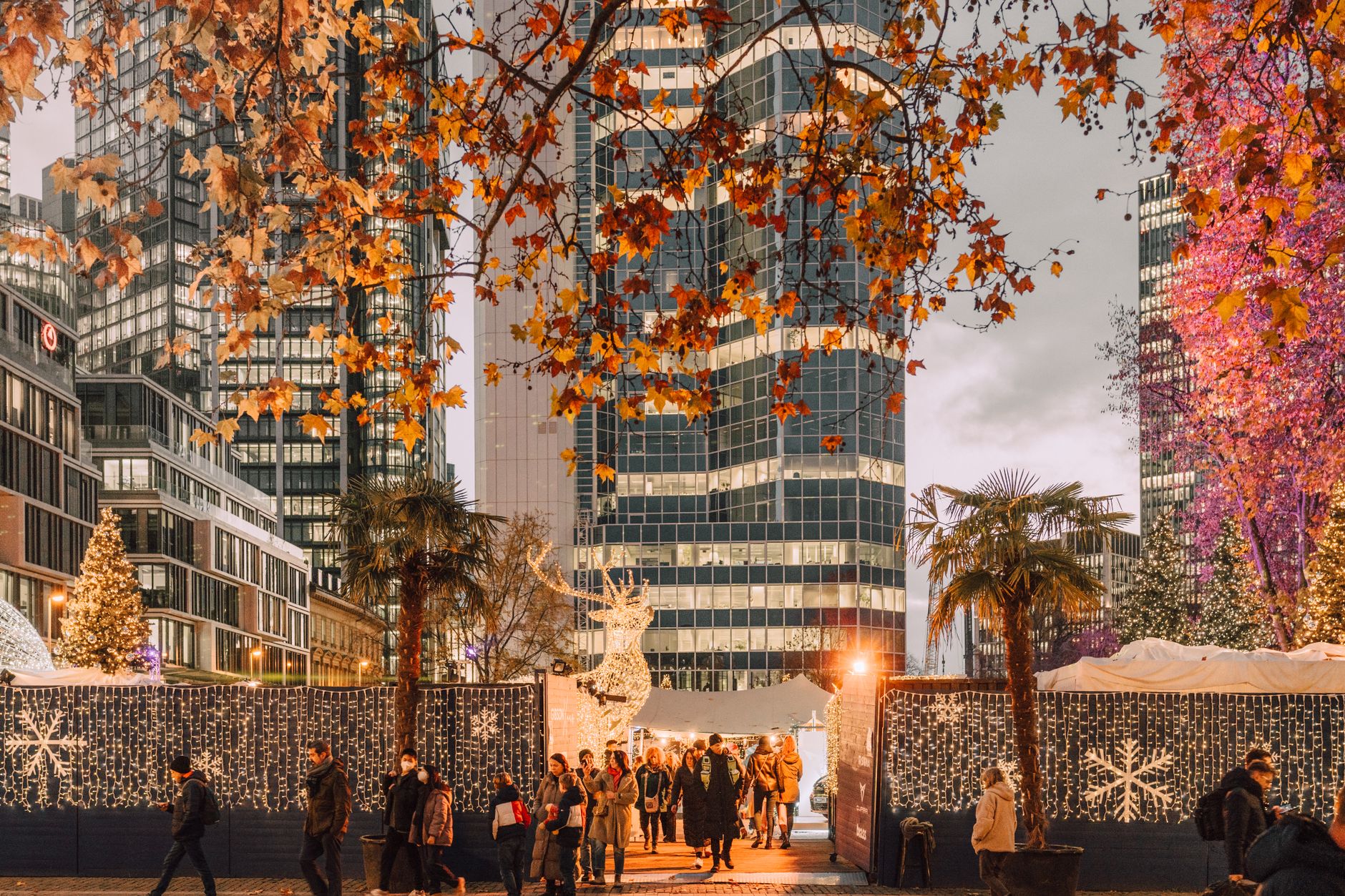
Attractions
Frankfurt Christmas Market: Dates, Stalls & Tips
The Frankfurt Christmas Market on the Römerberg: history since 1393, the usual dates and opening hours, the areas from Hauptwache to the Mainkai, specialities like Bethmännchen and hot apple wine — and tips against the crowds.
Katharina Vogt16 June 2026