Day Trip to Darmstadt from Frankfurt: Mathildenhöhe, Wedding Tower and Waldspirale
A World Heritage Site since 2021, celebrating its 125th anniversary in 2026, and less than 20 minutes from Frankfurt by regional train: why Darmstadt is, to my mind, the most underrated day trip in the region, and how to fit it into a single day without a car.

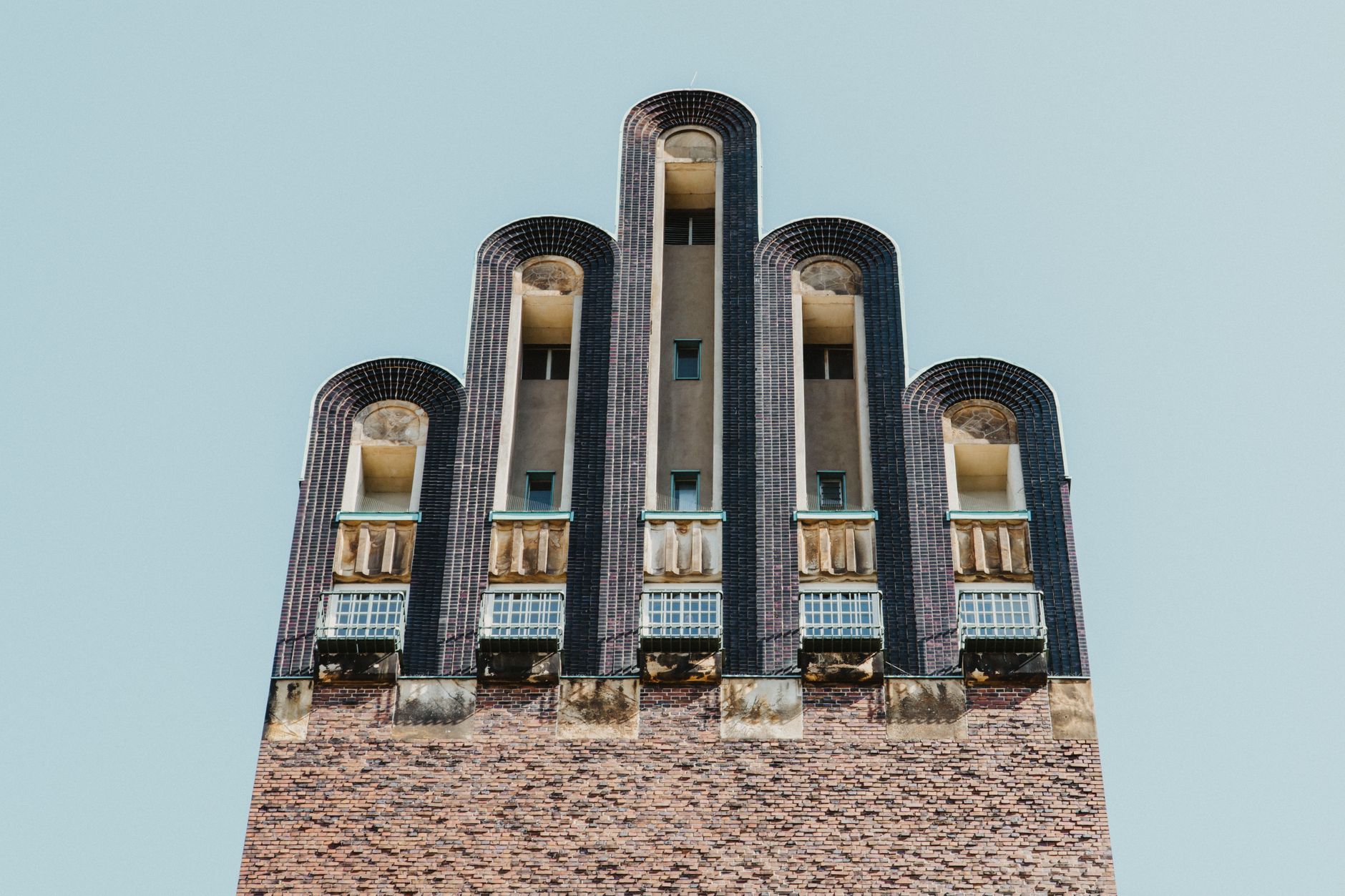
For years I knew Darmstadt only through a train window. That was a mistake, because a quarter of an hour south of Frankfurt stands one of the most singular ensembles in Europe: an artists’ colony on a hill, founded by a grand duke who brought architects and artists to Darmstadt around 1900 and let them rethink the house, the furniture and the townscape from scratch. The Mathildenhöhe has been a UNESCO World Heritage Site since 2021, and in 2026 it is marking 125 years since its first exhibition. I go several times a year, usually on a weekday, and every time I’m surprised by how much fits into a single day once you know the routes.
A quarter of an hour by regional train
Darmstadt is the easiest of all the day trips from Frankfurt, because you neither have to change trains nor get up at dawn. According to the RMV journey planner, two regional trains an hour run direct from Frankfurt Hauptbahnhof to Darmstadt Hauptbahnhof during the day: the RE60 in 17 minutes and the RB68 in 19. On top of that the S-Bahn runs twice an hour. One thing has changed here: since the December 2024 timetable change, the line to Darmstadt is no longer the S3 or S4 but the S6, extended from Friedberg through Frankfurt’s city tunnel and on via Langen to Darmstadt. It stops a good deal more often and takes 39 minutes from the Hauptbahnhof, so if you’re in a hurry, take the regional train. ICEs also cover the route in just under 20 minutes, but RMV tickets aren’t valid on them.
Fares are pleasantly simple, because the whole route lies within the RMV network. Frankfurt to Darmstadt is fare level 5 (Preisstufe 5, as of 2026):
- Single: €11.50, children €6.85.
- Day ticket (Tageskarte): €22.40. It just about pays for itself on a return trip, and according to the RMV fare information it is also valid within the Frankfurt and Darmstadt city areas, so it covers the local buses and trams too.
- Group day ticket: €38.30 for up to five people, the best choice from two adults upwards.
- Deutschland-Ticket: €63 a month; Deutsche Bahn states it is valid on RE, RB, S-Bahn, buses and trams, but not on ICE or IC trains.
How Frankfurt’s fare levels and day tickets work in general is covered in my article on public transport tickets and fares in Frankfurt.
The station you arrive at deserves a glance. Darmstadt Hauptbahnhof was completed in 1912, one of the major works of the architect Friedrich Pützer, in late Art Nouveau style. Fitting, since Art Nouveau (Jugendstil in German) is the theme of the day.
From the station up to the Mathildenhöhe
From the Hauptbahnhof, bus lines F and FM run straight to the Lucasweg/Hochzeitsturm stop, alternating roughly every quarter of an hour and taking about twelve minutes. From there it’s about 200 metres uphill. If you’d rather see the city centre first, a tram or bus gets you to Luisenplatz in five to nine minutes, and the same buses take six minutes from Luisenplatz to the tower.
Why the Mathildenhöhe is World Heritage
The story begins in 1897. That year Grand Duke Ernst Ludwig of Hesse founded an artists’ colony on the Mathildenhöhe, the highest point above the city, as a centre for the reform movements in architecture, arts and crafts. The members designed their own houses and studios as experiments in a new way of living and working, and the colony grew piece by piece through four major exhibitions in 1901, 1904, 1908 and 1914. UNESCO inscribed the ensemble in 2021 and describes it as a prototype of Modernism. The site comprises 23 elements, from the Wedding Tower, the Exhibition Hall and the Plane Tree Grove to 13 artists’ houses and studios.
The good news: admission is charged for the tower, the museum and the Exhibition Hall, while the Plane Tree Grove and looking at the artists’ houses from outside cost nothing.
The Wedding Tower: five fingers above the city
The city’s landmark is the Hochzeitsturm or Wedding Tower, designed by Joseph Maria Olbrich for the 1908 exhibition. The city gave it to the Grand Duke to mark his second marriage, to Eleonore of Solms-Hohensolms-Lich, in 1905. The dark brick tower ends in five crenellations of different heights that look like a raised hand, which is why locals also call it the Five-Finger Tower. The Institut Mathildenhöhe gives its height as almost 50 metres, with 209 steps up to the viewing level. In the bombing raid of 1944 only the roof of the five crenellations was destroyed; otherwise the tower survives in its original state.
Inside, look out for the mosaics by Friedrich Wilhelm Kleukens in the entrance hall, among them “The Kiss”, and the two princely rooms on the fourth and fifth levels, with murals by Fritz Hegenbart and Philipp Otto Schäfer. They are used for weddings today, and that matters for your plans: on wedding days access to the tower is restricted. The Förderkreis Hochzeitsturm, the association that runs it, gives the exact times on those days by phone on +49 6151 701 90 87.
The viewing platform is on the seventh floor. To the west, on a clear day, you can see as far as the Donnersberg in the Palatinate; to the north, in the distance, the Frankfurt skyline, which has a charm all of its own from here. From March to September it’s open Monday to Thursday 10am–7pm and Friday to Sunday 10am–8pm; in October Tuesday to Sunday 10am–6pm; and from November to February Tuesday to Sunday 11am–5pm. Admission is €4, reduced €2, and children under 12 go free (as of 2026).
The Exhibition Hall, the Ernst Ludwig House and the Plane Tree Grove
Right next to the tower stands the Exhibition Hall, built by Olbrich in 1907–08 on top of a former reservoir dating from 1880. The broad terrace in front serves as both entrance and viewpoint. For the anniversary year the Institut Mathildenhöhe is showing the special exhibition “A Step Ahead – 125 Jahre Mathildenhöhe Darmstadt” here, which devotes one hall to each of the four historic building exhibitions and sets them against contemporary design. The coloured 3D reconstructions of the 1901 and 1914 exhibitions are the part I find most striking. The show is part of the World Design Capital Frankfurt RheinMain 2026 programme. During the exhibition it is open Tuesday to Sunday 11am–6pm; admission is €10, reduced €8.
A few steps on stands the Ernst Ludwig House, which Olbrich built as the colony’s studio building for the first exhibition in 1901, at the highest point of the site. Take a close look at the entrance: the omega-shaped arch, the gilding and the two larger-than-life figures, “Strength” and “Beauty”, by Ludwig Habich. Today it houses the Museum Künstlerkolonie (Artists’ Colony Museum), showing work by the colony’s 23 members; the collection display “Raumkunst – Made in Darmstadt” presents more than 150 pieces of furniture, ceramics, textiles and designs by Olbrich, Peter Behrens, Albin Müller and others. It’s open Tuesday to Sunday 11am–6pm; admission €5, reduced €3, free for under-18s. Note that the museum currently doesn’t take cash. A combined ticket for the Exhibition Hall and the museum has cost €12 (reduced €10) since 7 June 2026 and is sold on site only (as of 2026).
Between the buildings lies the Plane Tree Grove, laid out around 1830 and given sculptures, reliefs and inscriptions on the cycle of life by Bernhard Hoetger for the 1914 exhibition. It is freely accessible, still planted with its regularly spaced, clipped trees, and to my mind the quietest and loveliest spot on the whole hill.
The Russian Chapel: golden domes on Russian soil
In the middle of the Art Nouveau ensemble, golden onion domes suddenly appear. The Russian Chapel of St Mary Magdalene was built independently of the artists’ colony. Ernst Ludwig’s sister Alix, a granddaughter of Queen Victoria, married Nicholas II, the last Tsar of Russia, and took the name Alexandra Feodorovna. For the imperial family’s visits to Darmstadt, Nicholas paid out of his private funds for the chapel, built between 1897 and 1899 to plans by Leon Benois on Russian earth brought specially for the purpose. The decoration was designed by Viktor Vasnetsov, and the apse mosaic of the Mother of God came from the Frolov brothers’ workshop in St Petersburg. The bells are still rung by hand.
Today it is the church of Darmstadt’s Russian Orthodox congregation and can be visited outside services. According to the parish, it’s open Tuesday to Saturday 11am–3pm and Sunday 2–4pm, and closed on Mondays (as of 2026). Other websites list longer hours; I go by the parish’s own times and fit the chapel in before lunch.
Hundertwasser’s Waldspirale
After so much Art Nouveau, the Waldspirale is the perfect contrast. This apartment building in the Bürgerparkviertel north of the city centre was completed in 2000, designed by Friedensreich Hundertwasser and realised by the architect Heinz M. Springmann for the housing company Bauverein AG. It spirals up from two to twelve storeys, with a garden growing on its roof, golden onion domes, colourful ceramic columns and more than a thousand windows, no two alike. According to Darmstadt Marketing, recycled concrete was used here for the first time.
One important point: the Waldspirale is an ordinary residential building with 105 rented flats, not an attraction with a ticket desk. You can look at it from outside and walk into the courtyard with its playground and pond, but please keep your voice down and respect the residents. The cafés and bars that once operated at the top of the building are not currently open. If you want to know more, Darmstadt Marketing runs a one-hour guided walk, “Rundgang um ein Kunstwerk”, from €11.50, booking required; it meets at the passage into the courtyard. Trams 4 and 5 run from Luisenplatz to the Waldspirale stop in six minutes.
The Hessisches Landesmuseum
The third big draw is right in the centre, at Friedensplatz 1 near the palace. The Hessisches Landesmuseum (Hessian State Museum) is a building by Alfred Messel, opened in 1906 and reopened on 13 September 2014 after a long renovation. It suits a day trip perfectly because it shows art and natural history under one roof. I always head first for the fossils from the Messel Pit, itself a UNESCO World Heritage Site, where the museum takes part in the excavations. Then on to the Block Beuys, seven rooms of work by Joseph Beuys installed in 1970, and finally the Art Nouveau collection of more than 400 objects, which brings the day neatly back to the Mathildenhöhe. Fans of Böcklin will find the largest collection of his paintings in any German museum.
It’s open Tuesday, Thursday and Friday 11am–6pm, Wednesday until 8pm, and Saturday, Sunday and public holidays 11am–6pm; closed on Mondays. The permanent collection costs €8, reduced €5, and children and young people up to 18 go free (as of 2026). One current note: the museum is closed on Saturday 26 September 2026. The nearest stops are Schloss, Luisenplatz and Willy-Brandt-Platz.
And by car?
You don’t need a car, but some people want one anyway. The drive between Darmstadt and Frankfurt is around 36 kilometres, about half an hour without traffic, and before you set off it’s worth running the numbers through a fuel cost calculator that works out cost per trip and per person. If you’d rather take a cab back, our colleagues explain how longer out-of-town fares are built up in their piece on what a 50-kilometre taxi ride in Germany really costs. Directly beneath Friedensplatz by the Landesmuseum is the Q-Park Schlossgaragen car park. And if you’re thinking of parking on the edge of town and continuing by tram, bear in mind that park and ride is priced and run differently in every German city before you rely on it.
My Darmstadt day
This is how I like to do it: around nine, the RE60 or RB68 from Frankfurt; at Darmstadt Hauptbahnhof, bus F or FM up to the Wedding Tower while it’s still quiet at the top. Then the Russian Chapel before it closes in the early afternoon, a walk through the Plane Tree Grove and the exhibition in the Exhibition Hall. Down into the centre for lunch, followed by two hours in the Landesmuseum. In the late afternoon, the tram out to the Waldspirale, a lap round the building, and back to the Hauptbahnhof. A day ticket covers the lot.
A bonus tip if you’re flying home: Darmstadt works for your last day too. The AirLiner bus runs from Luisenplatz directly to Frankfurt Airport, taking around 45 minutes according to the RMV. Leave yourself plenty of buffer, and read up beforehand on how airport security screening works in 2026 and how long you’ll realistically queue.
If Darmstadt gives you a taste for more, my overview of day trips around Frankfurt has plenty of other ideas, and for a comparison, the day trip to Heidelberg is more romantic but further away. Darmstadt, on the other hand, is the trip you can take on a whim on a grey Tuesday and still come home feeling you’ve seen something big.
Keep reading
Day Trips
Day Trip to Heidelberg from Frankfurt: Getting There & Plan
Heidelberg in a day from Frankfurt: getting there by train or car, prices (as of 2026) and a tried-and-tested plan with the old town, castle, funicular, Old Bridge and Philosophers' Walk.
Katharina Vogt16 June 2026
Day Trips
Day Trip to the Taunus: Feldberg, Königstein, Bad Homburg
The Taunus in a day from Frankfurt: the S5, the U3 and the catch in the Feldberg bus line 57, walking on the Großer Feldberg, Königstein's castle ruin, Bad Homburg's spa park and the Saalburg on the World Heritage Limes — with prices and times (as of 2026).
Katharina Vogt17 September 2026
Day Trips
Day Trips with Kids around Frankfurt: The Best Outdoor Destinations
Family outings around Frankfurt: the zoo and the Opel-Zoo, the Taunus with the Großer Feldberg, the Hessenpark open-air museum, the Lochmühle theme park, Taunus Wunderland, a high-ropes course and a Main river cruise — with prices, hours and how to get there (as of 2026).
Katharina Vogt28 July 2026
Day Trips
Day Trip to the Rheingau: Rüdesheim by Train & Cable Car
Rüdesheim in a day from Frankfurt: just over 70 minutes on the RheingauLinie, the cable car to the Niederwald Monument, the ring tour with chairlift and boat, the Drosselgasse, Riesling and Kloster Eberbach.
Katharina Vogt16 June 2026